ebooks now available from Amazon by Tax Attorney Richard S. Lehman, Esq.

These ebooks are part of Lehman Tax Law knowledge-based learning. On-demand videos on all topics of United States Taxation are offered at no cost and available at www.USTaxLawSeminars.com


Taxation of the clawback in a ponzi scheme

Taxation of the Clawback in a Ponzi Scheme - Maximum Recovery

US: https://www.amazon.com/dp/B00J36H1WM
FR: https://www.amazon.fr/dp/B00J36H1WM
BR: https://www.amazon.com.br/dp/B00J36H1WM
IN: https://www.amazon.in/dp/B00J36H1WM
ES: https://www.amazon.es/dp/B00DGVGSUG
CA: https://www.amazon.ca/dp/B00J36H1WM
UK: https://www.amazon.co.uk/dp/B00J36H1WM
IT: https://www.amazon.it/dp/B00J36H1WM
MX: https://www.amazon.com.mx/dp/B00J36H1WM
DE: https://www.amazon.de/dp/B00J36H1WM
JP: https://www.amazon.co.jp/dp/B00J36H1WM
AU: https://www.amazon.com.au/dp/B00J36H1WM


Ponzi Scheme and Tax Loss

US: https://www.amazon.com/dp/B0084GHAFA
FR: https://www.amazon.fr/dp/B0084GHAFA
BR: https://www.amazon.com.br/dp/B0084GHAFA
IN: https://www.amazon.in/dp/B0084GHAFA
ES: https://www.amazon.es/dp/B0084GHAFA
CA: https://www.amazon.ca/dp/B0084GHAFA
UK: https://www.amazon.co.uk/dp/B0084GHAFA
IT: https://www.amazon.it/dp/B0084GHAFA
MX: https://www.amazon.com.mx/dp/B0084GHAFA
DE: https://www.amazon.de/dp/B0084GHAFA
JP: https://www.amazon.co.jp/dp/B0084GHAFA
AU: https://www.amazon.com.au/dp/B0084GHAFA


Steuerplanung für Ausländische Anleger, die in U.S. Immobilien investieren wollen

US: https://www.amazon.com/dp/B00DGVGSUG
FR: https://www.amazon.fr/dp/B00DGVGSUG
BR: https://www.amazon.com.br/dp/B00DGVGSUG
IN: https://www.amazon.in/dp/B00DGVGSUG
ES: https://www.amazon.es/dp/B00DGVGSUG
CA: https://www.amazon.ca/dp/B00DGVGSUG
UK: https://www.amazon.co.uk/dp/B00DGVGSUG
IT: https://www.amazon.it/dp/B00DGVGSUG
MX: https://www.amazon.com.mx/dp/B00DGVGSUG
DE: https://www.amazon.de/dp/B00DGVGSUG
JP: https://www.amazon.co.jp/dp/B00DGVGSUG
AU: https://www.amazon.com.au/dp/B00DGVGSUG

Posted in Domestic Taxation, United States Taxation of Foreign Investors

Video: The IC-DISC and U.S. Tax Benefits for Exporting

In this video Veteran South Florida Tax Attorney Richard S. Lehman will explain:

U.S. Tax Benefits for Exporting. NOW updated to include: The Export Disc Corporation Computer Software And Internet Sales And Licenses.

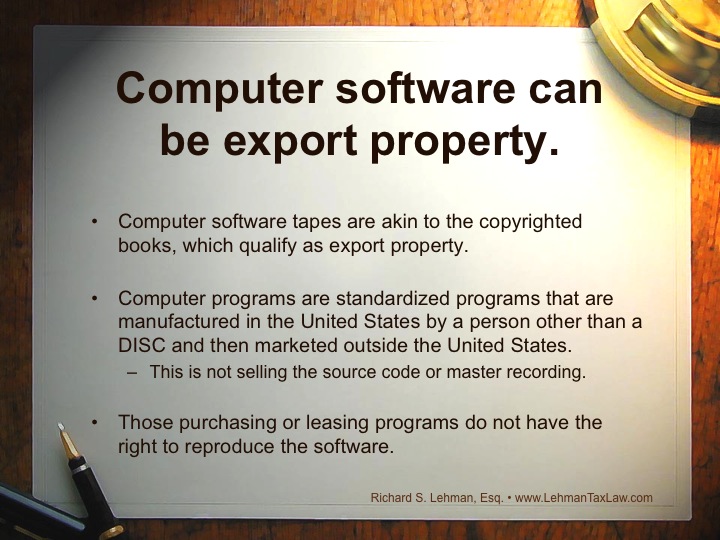
With export profits hard to come by, U.S. taxpayers that sell, lease or license “export property” which is manufactured, produced or grown in the United States (not more than 50% of which attributable to U.S. imports), can take advantage of strong support for their export profits in the Internal Revenue Code.

Posted in Exporting Tax Benefits The IC-DISC

Pre Immigration Income Tax Planning

Substantial Presence Test

Richard S. Lehman Esq. is posting frequently asked questions recently received on the topic: Tax planning techniques for the foreign real estate investor.

Question 1: What unique tax applies to foreign corporations that does not apply to any other Taxpayers?

Answer: There is a unique tax on Foreign Corporations that do not distribute cash reserves from earnings and profits earned in the U.S. The corporation must either reinvest the cash in U.S. assets, or distribute the cash as dividends or suffer a tax known as “Branch Tax”. This can be an additional 30% tax on profits in addition to the foreign corporate income tax.

Question 2: How can a Foreign Investor avoid the United States estate taxes on his or her U.S. real estate investment if the Foreign Investor dies owning U.S. real estate?

Answer: Foreign Corporation. The major advantage of the Foreign Corporation as an investment vehicle is the fact that there will be no U.S. estate if the Foreign Investor were to pass away (estate tax); owning a Foreign Corporation that owns U.S. real estate, nor will there be any gift tax (on the transfer of the shares) of the Foreign Corporation if a foreign investor makes a gift of such shares.

Questions 3: May a Foreign Investor invest in a corporation and avoid paying corporate and individual tax on the gain from the sale of U.S. real estate?

Answer: Yes, once a corporation, Foreign or U.S., has sold all of its U.S. real estate holding and paid the single tax at the operating level of the corporation, the corporation may liquidate and distribute its assets to its foreign shareholders free of tax.

Further, a Foreign Investor who wants to use just a U.S. Corporation to own the U.S. real estate investment will receive the same benefit from liquidating that corporation. The “Second Tax” that usually occurs when cash is distributed from a corporation’s profits can be eliminated.

All of this is accomplished by a single exception in the internal revenue code that governs corporations that invest in United States real estate. Once a corporation that invests in U.S. real estate, (whether it’s a foreign corporation or a domestic corporation), pays all of its U.S. taxes on all the real estate that it owns in the United States, it can liquidate and it can distribute all of the cash that it has from the sale of those assets free of tax to the investor.

Question 4: Can a Foreign Investor use corporate entities to avoid the U.S. estate tax and the Branch Tax and pay only a single tax on gain from U.S. real estate?

Answer: Yes, the Tiered Corporation is a typical investment entity for Foreign Investors and has the capability of meeting each and every one of the tax objectives discussed. A Tiered corporate structure consists of a corporation organized in any jurisdiction outside of the United States that is owned by the Foreign Investor[s]. The Foreign Corporation can then own 100% of the shares of a U.S. corporation that will own the real estate.

This insures that if the Foreign Investor wishes to transfer his or her shares as a gift or would die owning shares in a Foreign Corporation (which indirectly ultimately owned U.S. real estate) there would be no gift or estate taxation on the transaction.

At the same time, the Tiered Corporate Structure prevents the Foreign Corporation holding company from being exposed to the Branch Tax. This is because the second entity in the tier is a U.S. corporation formed in the U.S. These U.S. corporations are subject to the 35% maximum taxation on their operating income.

Question 5: Can a Foreign Investor in U.S. real estate receive interest payments from loans to finance U.S. real estate investments free of all U.S. income taxes and estate taxes?

Answer: Yes, if a foreign investor receives interest income from a United States corporation or a United States person, or any United States entity investing in real estate, the general rule will be a 30% withholding tax on that interest.

However, in order to attract foreign capital in the form of loans and not equity, a unique exemption from the Federal income tax exists on a certain type of interest income paid to a Foreign Corporate or Foreign Individual Investor (the “Lender”). This tax advantage is known as the Portfolio Interest Exemption. This exemption permits interest on U.S. debt instruments to be exempt from the gross basis tax if the interest income is payable to Foreign Persons under certain circumstances.

To take advantage of this, the Foreign Investor must limit his or her equity ownership in the U.S. real estate investment. The portfolio debt interest payments are not only excluded from the foreign Lenders U.S. taxable income, in addition the Foreign Person that owns the Portfolio Obligation will also not be subject to U.S. estate taxation if they die owning the Obligation. Therefore, a Foreign Individual Investor that holds only a Portfolio Interest Obligation in a real estate investment does not need any other estate tax planning.

Question 6: Can an Investor invest in U.S. real estate and pay no U.S. tax when the U.S. real estate is sold.

Answer: Yes, there is a unique aspect to the U.S. tax laws when it comes to investing in U.S. real estate. If a foreign corporation invests directly in United States real estate and if the foreign shareholder can sell the shares of his or her foreign corporate stock to a buyer instead of the real estate, the shares of that Foreign Corporation that owns U.S. real estate directly can be sold by the Foreign Investor for no tax whatsoever.

However, in that case the buyer will acquire a corporation that owns the real estate. This means the buyer will own the real estate at the original cost and if the Foreign Corporation that was purchased ever sells that real estate, then there will be a tax on the Foreign Corporation when it sells the real estate.

Posted in Pre-immigration income tax planning, United States Taxation of Foreign Investors

This article has been translated into French - it is a general overview of United States Taxation of Foreign Investors

Système d’Imposition des Investisseurs Etrangers aux Etats-Unis

  1. Système d’Imposition Américaine des Sociétés Etrangères et des Etrangers Non Résidents Règles Générales
  2. Planning Fiscal Avant d’Immigrer aux Etats-Unis
  3. Planning Fiscal pour l’Investisseur Etranger de Biens Immobiliers

INTRODUCTION

Pendant de nombreuses années, les Etats-Unis ont été un refuge pour les investisseurs étrangers. Actuellement, ce pays n’est pas uniquement devenu un abri sûr pour les investisseurs étrangers, mais également une nation, qui dispose d’innombrables atouts au niveau des biens immobiliers et des affaires commerciales qui sont offerts sur le marché à des prix avantageux suite à la chute abrupte du dollar américain.

Un aspect méconnu, toutefois, est que les lois fiscales aux Etats-Unis sont très favorables à l’investissement étranger et prévoient occasionnellement le paiement aux investisseurs étrangers d’intérêts hors taxes par les contribuables américains. Les plus-values en capital en provenance de l’investissement peuvent être hors taxes ou assujetties à des taux fiscaux de 15% et les lois complexes offrent de nombreuses méthodes qui permettent de différer le paiement des impôts américains à une date ultérieure.

Parallèlement, lesdites lois peuvent devenir des pièges fiscaux pour l’investisseur mal renseigné et avoir comme résultat qu’il paiera aux alentours de 65% d’impôts sur les gains et, en cas de décès, de 48% de droits de succession sur les biens aux Etats-Unis.

Ce guide descriptif aidera à fournir à l’investisseur étranger, en tant que société ou personne physique, une introduction de base aux lois fiscales aux Etats-Unis, telles qu’elles s’appliquent à l’investisseur étranger. Espérons que l’investisseur étranger se rendra compte qu’il est le bienvenu aux Etats-Unis. Ce guide devrait surtout informer l’investisseur étranger que les lois fiscales aux Etats-Unis sont complexes et qu’elles doivent être traitées avec une approche hautement professionnelle si on veut échapper aux pièges en matière fiscale et profiter des nombreux avantages fiscaux offerts par les Etats-Unis.

Les règles générales, dont il sera question dans cet exposé, ne doivent pas être considérées comme conseil légal ou fiscal et les contribuables devront s’en informer auprès de leurs conseillers juridiques, comptables et fiscaux.

Système d’Imposition des Investisseurs Etrangers aux Etats-Unis
Table des Matières

I. SCHEMA D’IMPOSITION

II. STATUT LEGAL POUR DES RAISONS FISCALES

III. DEUX TYPES DE STRUCTURES D’IMPOSITION SUR LE REVENU FÉDÉRAL

IV. L’IMPACT DES TRAITÉS BILATÉRAUX

V. TAXES SUR LES BÉNÉFICES D’UNE FILIALE

VI. PLANNING AVANT L’IMMIGRATION– IMPOTS SUR LES REVENUS ET GAINS

VII. PLANNING AVANT L’IMMIGRATION– DROITS DE SUCCESSION ET SUR LES DONATIONS

VIII. CIRCONSTANCES ATTÉNUANTES ET AVANTAGES SPÉCIAUX SUR LE PLAN FISCAL

IX. STRUCTURE D’IMPOSITION IMMOBILIERE

X. PROPRIÉTÉ DE BIENS IMMOBILIERS

XI. POLITIQUE DES AVANTAGES ET PIÈGES FISCAUX POUR L’INVESTISSEUR ÉTRANGER DE BIENS IMMOBILIERS

XII. LES STRUCTURES DE LA POLITIQUE FISCALE


I. SCHÉMA D’IMPOSITION

• Etranger Résident aux Etats-Unis (« Résident Fiscal ») Soumis à l’Impôt

a. Imposition sur les Revenus - Revenus Universels
b. Droits de Succession - Biens Universels
c. Droits sur la Donation - Biens Universels

• Etranger Non Résident - Soumis à l’Impôt

a. Imposition sur le Revenu- Revenu gagné aux Etats-Unis, Type Limité de Revenu gagné à l’Etranger
b. Droits de Succession - Biens aux Etats-Unis uniquement
c. Droits sur la Donation - Propriété Immobilière et Biens Corporels sis aux Etats-Unis

Il y a une énorme différence dans la façon où les Etats-Unis assoient des impôts sur le revenu, des droits de succession et sur la donation à un immigrant potentiel qui est considéré comme « résident fiscal », et à une personne qui a encore un statut légal d’ « étranger non résident ». Un résident fiscal sera soumis aux impôts américains sur le revenu, aux droits de succession et sur la donation au niveau universel, alors que, de manière générale, les étrangers non résidents paieront uniquement des impôts américains sur le revenu gagné aux Etats-Unis ainsi que des droits de succession uniquement sur la propriété immobilière et les biens corporels aux Etats-Unis ainsi que sur certains biens incorporels.

II. STATUT LEGAL POUR DES RAISONS FISCALES

• Résident pour des Raisons d’Imposition sur le Revenu

a. Green Card – Carte Verte
b. Preuve de Présence Importante
c. Choix Volontaire
d. L’Exception de la Connexion Proche
e. Les Traités: Une Epreuve Complémentaire

Etrangers Non Résidents - Impôts sur le Revenu
Un étranger non résident est par définition tout résident d’un pays autre que celui des Etats-Unis, qui n’est pas « résident américain » pour des raisons d’imposition sur le revenu aux Etats-Unis. En règle générale, un étranger n’est pas considéré comme résident américain d’un point de vue fiscal, si celui-ci ne dispose pas (1) d’une carte verte comme preuve de résidence permanente aux Etats-Unis ou (2) d’une « période de séjour importante » sur le territoire américain, comme décrit ci-dessous. Il y a évidemment des exceptions à cette règle, qui seront également prises en considération.

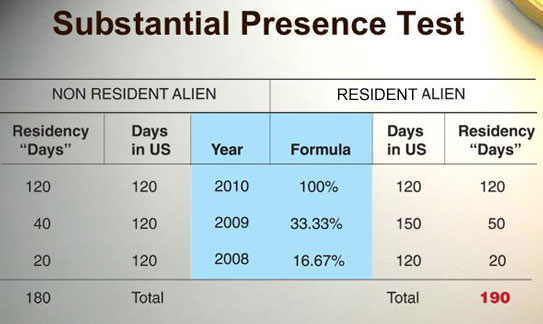
Un étranger a « une présence importante » aux Etats-Unis au cours de l’année civile où il est physiquement présent aux Etats-Unis pendant une période d’au moins 31 jours et, dans cette même année civile, pour un total joint de 183 jours ou plus au cours des trois années antérieures, selon une certaine formule, comme expliquée ci-après.

Afin de calculer cette période combinée de 3 ans - la formalité des 183 jours -, chaque jour, passé aux Etats-Unis pendant l’année civile “combinée” en cours, compte comme un jour complet, chaque jour de l’année précédente comme un tiers d’une journée et chaque jour de la deuxième année antérieure comme un sixième d’un jour. Voici un exemple concret:

Les Etats-Unis ont des traités d’imposition avec beaucoup de pays. De manière générale, ces traités prévoient que les résidents et les sociétés de chaque pays faisant partie du traité ont droit à un traitement fiscal plus libéral que les résidents et les sociétés de pays non adhérents aux traités. La notion de résidence sous les traités diffère de la définition générale et peut donner droit à un étranger non résident de passer plus de temps aux Etats-Unis chaque année sans être un résident assujetti au régime fiscal américain. En général, les traités fiscaux ne permettront à l’étranger de rester non résident pour des raisons fiscales aux Etats-Unis tant que cet étranger, couvert par le traité, restera moins de 183 jours sur le territoire américain par année individuelle et ne dépassera pas la période cumulative des trois ans.

Ce même genre de traitement, c’est à dire celui de permettre aux étrangers de prolonger leur séjour aux Etats-Unis de moins de 183 jours chaque année sans devenir résident fiscal aux Etats-Unis, est également accessible à certains étrangers qui sont ressortissants de pays n’ayant pas de traité fiscal avec les Etats-Unis. Si un étranger peut prouver que sa société a des liens étroits avec son pays d’origine, la preuve de la présence importante est prolongé en raison de sa “connexion plus étroite” avec un pays étranger qu’avec les Etats-Unis.

La Société Etrangère – Impôts sur le Revenu

Une société étrangère est reconnue comme contribuable individuel pour des raisons fiscales aux Etats-Unis. Une société étrangère pour des raisons fiscales aux Etats-Unis est une société qui n’est pas établie sous les lois américaines ou celles d’un des états des Etats-Unis. Les statuts d’une société étrangère spécifieront si la société est étrangère ou une société nationale américaine.

III. DEUX TYPES DE STRUCTURES D’IMPOSITION SUR LE REVENU FÉDÉRAL

Les Contribuables Américains (Citoyens et Etrangers Résidents)
De manière générale, les sociétés nationales américaines, les citoyens et résidents aux Etats-Unis sont taxés par les Etats-Unis sur leur revenu net universel, quelle que soit l’origine des revenus. Des exceptions à cette règle existent uniquement pour éviter la “double imposition” du revenu étranger gagné par des Américains et par des Sociétés américaines à l’étranger. La double imposition est évitée en permettant aux contribuables américains d’obtenir un crédit pour leurs impôts américains équivalant au montant des impôts étrangers payés sur ce même revenu.

Le Contribuable Etranger
Cependant, les Contribuables Étrangers (aussi bien les personnes physiques que les sociétés) paient des impôts sur leur revenu américain de deux façons complètement différentes : soit le revenu gagné par le Contribuable Etranger est d’origine « passive » soit est-il généré par le Contribuable Etranger d’un commerce ou une affaire active aux Etats-Unis.

En outre, les règles fiscales américaines pour les Contribuables Etrangers tiennent compte du fait que la juridiction des Etats-Unis peut s’étendre à ce point-là. Par conséquent et de manière générale, un Contribuable Etranger paiera uniquement des taxes sur le “Revenu d’Origine Américaine » et non pas sur les revenus provenant de l’extérieur des Etats-Unis. Il y a toutefois des exceptions.

Afin de comprendre les deux types d’imposition différents, il est important d’examiner les règles générales qui dictent si un Contribuable Etranger exerce une “affaire active aux Etats-Unis” ou un “investissement passif”, de même que les règles qui s’appliquent à « l’origine du revenu » et « l’origine des retenues”. Ces définitions déterminent laquelle des deux sortes de règles fiscales doit être appliquée afin de mesurer la responsabilité fiscale américaine des sociétés étrangères et celle des investisseurs étrangers non résidents.

• Règles de l’Origine des Revenus

a. Revenus d’Origine Américaine
b. Revenus d’Origine Étrangère
c. Retenues

Les règles, qui détermineront si le revenu provient des Etats-Unis ou de l’étranger pour des raisons fiscales américaines, sont les suivantes :

  1. Rétribution pour des services personnels. L’origine du revenu résultant des services personnels se trouve là où les services sont fournis.
  2. Loyers et Redevances. Le revenu de loyers ou de redevances a son origine là où se trouve l’endroit ou lieu d’utilisation de la propriété louée ou exploitée.
  3. Revenus et Plus-values d’une Propriété Immobilière. Les revenus et bénéfices de la location ou la vente d’un bien immobilier ont leur origine à l’endroit où ce bien se trouve.
  4. Vente d’une propriété personnelle. Traditionnellement, l’origine du rapport de la vente d’une propriété personnelle est là “où la vente a eu lieu”, ce qui correspond, de manière générale, à l’endroit où le titre est transféré aux biens ; toutefois les règles sont devenues plus complexes et d’autres facteurs entrent en jeu.
  5. Intérêt. L’origine des revenus d’intérêt est en général déterminée en fonction de la résidence du débiteur; des intérêts payés par un résident des Etats-Unis constituent une source de revenu américaine, alors que les intérêts payés par des non résidents, n’étant pas des citoyens américains, sont généralement considérés comme revenus d’origine étrangère.
  6. Dividendes. L’origine des revenus de dividendes dépend généralement de la nationalité ou du lieu de constitution de la société du payeur social; en d’autres termes, les répartitions par des sociétés américaines constituent un revenu d’origine nationale, alors que celui des dividendes des sociétés étrangères est considéré d’origine étrangère. Il y a toutefois plusieurs exceptions importantes à ces règles.
  7. Une Partie à l’Intérieur et Une Partie à l’Extérieur. Il y a une série de règles qui tiennent compte des origines de revenus qui peuvent être gagnés partiellement aux Etats-Unis et partiellement en provenance de sources étrangères comme, par exemple, des revenus des services de transport dont une partie est fournie sur ou une partie en dehors du territoire américain; les rentrées de la vente de propriétés de stocks, “produites”, “créées”, “fabriquées”, “manufacturées”, “extraites”, “préservées”, “remédiées”, ou “vieillies” sans l’aide et vendues à l’intérieur des Etats-Unis ou vice versa ainsi que d’autres genres de revenus. De manière générale, ceci est fait sur base d’adjudication entre les pays d’origine.

Origines des Retenues
Les règles d’origine en matière de retenues sont drôlement moins spécifiques que celles qui ont un rapport avec le revenu brut. Les règles sur les retenues des revenus gagnés aux Etats-Unis par un Contribuable Etranger prévoient simplement que le revenu imposable d’origines nationale ou étrangère est à déterminer en répartissant et en assignant correctement frais, pertes et autres retenues aux revenus bruts auxquels ils sont associés.

• Imposition des Revenus Passifs (Revenu Non Social)

a. Impôt de Quotité de 30% – Revenu brut
b. Impôts Retenus à la Source

• L’Imposition des Revenus Passifs
Si le revenu d’un Contribuable Etranger est passif de nature et ne dérive pas d’un “commerce continu ou d’une affaire active”, le revenu d’investissement d’origine américaine du Contribuable Etranger sera taxé d’un Impôt de Quotité de 30% (sans retenues). De manière générale, les types de revenus passifs gagnés par des investisseurs sont par exemple des intérêts, des dividendes, des redevances et d’autres paiements périodiques qui dérivent de l’autorisation de marques déposées, d’un fonds de commerce et de nombreuses sortes de propriété intellectuelle. Les Investisseurs Etrangers qui n’ont qu’un revenu américain passif ne sont généralement pas assujettis à l’imposition sur les plus-values et d’autres ressources exceptionnelles d’origine américaine.

Puisqu’en règle générale les Contribuables Etrangers ayant des rentrées passives aux Etats-Unis n’ont que des liens limités avec les Etats-Unis, une taxe appelée « système de retenue à la source » sera appliquée. Ce système oblige essentiellement la personne américaine qui paie le revenu passif à un Contribuable Etranger à recouvrir la taxe due et à la payer aux Etats-Unis. A défaut de paiement, la personne américaine qui est chargée de retenir cette taxe en sera personnellement responsable.

• Imposition des Revenus de Commerce ou d’une Affaire Commerciale Actifs

a. Des Taux Fiscaux Progressifs de Société
b. Des Taux Fiscaux Progressifs de Personnes Physiques
c. Un Revenu Connexe de Manière Effective.

Ce qui est d’une importance cruciale dans le cadre de l’imposition des Contribuables Etrangers aux Etats-Unis est de savoir si les personnes étrangères sont actives dans un commerce ou une affaire commerciale et, si tel est le cas, où se trouve le siège aux Etats-Unis. Les Contribuables Etrangers qui ont un commerce ou une affaire sont imposés de la même manière sur leur revenu d’origine américaine que les citoyens américains, les résidents fiscaux et les sociétés nationales. En d’autres termes, ils seront imposés sur leur revenu taxable d’origine américaine après retenues déductibles à des taux fiscaux progressifs.

Si le Contribuable Etranger est considéré comme actif dans un commerce ou une affaire aux Etats-Unis, cela dépendra de la nature et de l’étendue des contacts économiques du Contribuable avec les Etats-Unis. Il est évident que toutes les activités sociales ne doivent pas être centrées entièrement aux Etats-Unis.

La question la plus difficile est de savoir combien de fonctions de la société doivent se trouver sur territoire américain afin de créer un lieu de commerce américain?

Il est évident qu’une société pleinement intégrée, qui fabrique et vend la totalité de sa production aux Etats-Unis et qui est gérée et contrôlée aux Etats-Unis, est un commerce ou un business américain.

A l’opposé, il y a l’entreprise étrangère à 100% qui envoie des produits aux clients aux Etats-Unis, mais n’à aucun autre contact économique avec les Etats-Unis dans un commerce ou une affaire américaine. Néanmoins, entre les deux extrêmes, la présence d’un lieu commercial américain doit être déterminée cas par cas afin d’identifier l’endroit où le pur commerce avec les Etats-Unis franchit la ligne et commence à devenir un commerce aux Etats-Unis.

Il va de soi qu’au plus une société étrangère pénètre la structure économique et commerciale des Etats-Unis en profondeur, au plus elle donnera l’impression d’avoir établi un commerce ou un business aux Etats-Unis.

Des Revenus Liés de Manière Effective avec une Société Américaine
Contrairement au Contribuable Etranger qui est taxé sur ses revenus passifs américains uniquement, les revenus d’un Contribuable Etranger ayant un commerce ou une affaire aux Etats-Unis paiera des impôts sur tous les revenus générés aux Etats-Unis et, dans des circonstances limitées, des impôts américains doivent êtres payés sur les revenus d’origine étrangère et non américaine. Le revenu d’origine étrangère qui est attribuable à un commerce ou une affaire américaine du Contribuable Etranger peut être imposé par les Etats-Unis et est appelé « Revenu Lié de Manière Effective ».

Savoir si le revenu d’origine non américaine gagné par un Contribuable Etranger est taxé comme revenu “commercial”, dépendra du degré de rapprochement du revenu attribué au commerce américain du Contribuable Etranger.

Outre une partie du revenu d’origine étrangère étant soumise aux impôts américains, le revenu passif d’origine américaine peut être imposé comme revenu commercial s’il est considéré comme « Revenu Lié de Manière Effective ».

Il est possible parfois que les revenus d’origine américains passifs seront assujettis à un impôt sur les revenus nets et non pas aux 30% habituels appliqués aux revenus bruts. Par exemple, bien que les revenus d’intérêt soient normalement considérés comme « revenus passifs », il s’agit de “revenus d’un commerce actif” aux yeux d’une Banque Etrangère qui garde des dépôts et fait des affaires aux Etats-Unis. Par conséquent, l’intérêt gagné sur de tels dépôts ne serait pas taxé sur base d’un tarif uniforme, mais plutôt sur un tarif progressif qui permet des retenues de compensation pour les frais de la banque étrangère des fonds et d’autres frais dérivant du commerce aux Etats-Unis.

IV. L’IMPACT DES TRAITÉS BILATÉRAUX

Traités Fiscaux Bilatéraux
Le rôle des traités fiscaux bilatéraux dans le domaine de l’imposition des Contribuables Etrangers sur leur revenu d’origine américaine est fréquemment beaucoup plus important que les règles générales de bases susmentionnées. Les traités fiscaux entre les Etats-Unis et d’autres pays peuvent fonctionner pour (1) réduire (ou même éliminer) le taux des impôts américains sur certains types de revenus américains générés par les Contribuables Etrangers dans le pays membre du traité ; (2) neutraliser plusieurs règles statutaires sur l’origine des revenus ; (3) exonérer certains types de revenus ou activités d’impôts, par un ou les deux pays membres du traité; et (4) donner crédit pour les impôts réclamés par un pays en cas de situations où la loi nationale ne prévoit aucune disposition.

Le but principal des traités fiscaux bilatéraux américains est d’éviter le potentiel pour la double imposition dérivant des juridictions fiscales qui se chevauchent (par exemple, l’origine du revenu occasionnée dans un pays alors que le contribuable est résident dans l’autre pays).

V. TAXES SUR LES BÉNÉFICES D’UNE FILIALE

La Taxe sur les Bénéfices d’une Filiale
Il existe une taxe additionnelle dont les sociétés étrangères doivent être au courant. C’est le plus grand piège pour les moins avertis. S’il n’est pas question de bénéfices fiscaux d’un traité fiscal applicable aux Etats-Unis, une Société Etrangère peut être assujettie non seulement aux impôts sur les revenus en Floride et au niveau Fédéral en même temps s’élevant à 40%, mais, selon les faits et circonstances, les sociétés étrangères avec revenus dérivant des investissements aux Etats-Unis pourraient être soumises à une taxe additionnelle aux Etats-Unis appelée la Taxe sur les Bénéfices d’une Filiale. La taxe qui est de 30% et appliquée au revenu américain qui ne soit pas distribué comme dividende ni réinvesti dans des biens américains par la Société Etrangère.

Planning Fiscal Avant D’Immigrer aux Etats-Unis
Protéger les Intérêts Financiers de l’Immigrant Avant l’Impôt de la Résidence

VI. PLANNING AVANT L’IMMIGRATION – Impôts sur le Revenu et les Profits

• But – Minimiser les Gains et les Impôts sur le Revenu aux Etats-Unis

a. Avant de devenir un résident fiscal aux Etats-Unis, un étranger non résident voudra s’assurer s’il ne devra pas payer des impôts aux Etats-Unis sur l’argent qui, d’une certaine façon, a été gagné avant sa résidence.

Par conséquent, la stratégie clé est d’accélérer les gains avant sa résidence pour que ceux-ci, acquis pendant qu’il était étranger non résident, ne soient pas assujettis aux impôts américains après avoir obtenu sa résidence. Un exemple de cette accélération serait de négocier des valeurs sans faire de profit et de les vendre avant sa résidence. Il n’y aurait pas d’impôt à payer sur le gain et les actions pourraient être rachetées sur une nouvelle base élevée.

Assumons qu’un étranger non résident possédait des actions de Ford Motor Company pour une valeur d’un million de dollars, achetées à 100.000 dollars chacune. Si les actions ont été vendues après avoir assumé la résidence fiscale américaine, il y aura des impôts à payer sur les 900.000 dollars en profits. Si ces mêmes actions avaient été vendues par un non résident avant d’obtenir la résidence fiscale aux Etats-Unis, il n’aurait pas été imposé sur ce profit.

b. Une autre stratégie clé est d’accélérer le revenu dont le paiement est attendu après la résidence. Des paiements devraient être recouvrés avant la résidence. Voici quelques exemples d’accélération du revenu:

1. L’Exercice des options d’achat d’actions (stock-options)
2. L’Accélération des répartitions imposables provenant des plans de compensation différés
3. L’Accélération des gains sur des ventes à tempérament

c. Le fait de reconnaître une perte peut également être différé avant d’obtenir la résidence afin de l’utiliser comme gain après avoir obtenu la résidence. Des biens ayant une juste valeur du marché en dessous du coût peuvent être vendus après la résidence.

VII. Planning Avant l’Immigration - Droits de Succession et sur les Donations

• Résidence Fiscale en matière de Mutation et de Donation

Un étranger non résident peut être assujetti aux droits de succession et sur la donation aux Etats-Unis. Toutefois, les étrangers non résidents sont assujettis à ces droits uniquement sur les biens sis aux Etats-Unis.

La définition de non résidence aux fins d’imposition en matière de droits de succession et sur la donation est complètement différente que celle de la résidence pour des raisons fiscales sur le revenu. Un étranger non résident pour des raisons fiscales en matière de droits de succession et sur la donation est une personne dont le “domicile” se trouve dans un pays autre que les Etats-Unis. Le domicile est un test subjectif basé sur l’intention de quelqu’un de résider dans un pays.

• But - Minimiser les Droits de Succession aux Etats-Unis

a. La stratégie clé est de réduire les actifs de quelqu’un au minimum, avant d’établir la résidence et de voir où il y a moyen d’avoir un certain contrôle sur ces avoirs.
b. Les donations aux tierces personnes devraient être faites avant la résidence.
c. Les donations de Propriété sise sur territoire américain

1. Biens Corporels - Changement Physique d’un Endroit vers un Endroit Etranger Avant Donation.
2. Biens Immobiliers - Apport de biens et don de capital dans une société étrangère.

d. Transferts en Fidéicommis aux Bénéficiaires.

VIII. CIRCONSTANCES ATTÉNUANTES ET AVANTAGES SPÉCIAUX SUR LE PLAN FISCAL

• Etudiants

a. Un étudiant étranger qui a obtenu un statut d’immigration adéquat ne sera pas considéré comme résident américain du point de vue fiscal même s’il est ici pour une période importante où il serait normalement soumis aux impôts comme un étudiant, qui réside aux Etats-Unis.

b. Ce visa d’étudiant lui permet non seulement d’étudier aux Etats-Unis, mais également de payer des impôts uniquement sur le revenu d’origine américaine et non pas universelle. Le visa permet en outre aux membres proches de la famille d’accompagner l’étudiant aux Etats-Unis et de recevoir les mêmes avantages fiscaux.

c. Admettons qu’une femme sud-américaine de 40 ans, mariée à un homme d’affaires sud-américain extrêmement puissant, qui accompagne son épouse aux Etats-Unis avec leurs deux enfants, vient ici comme étudiante. Le revenu annuel de son époux s’élève à 1 million de dollars et a été gagné en travaillant dans le système bancaire en Colombie. Il n’a pas de revenu aux Etats-Unis. Dans ce cas-là, du point de vue fiscal américain, cet homme d’affaires sera exonéré d’impôts aux Etats-Unis sur ses revenus universels pendant qu’il vit aux Etats-Unis à temps plein pour moins de cinq ans consécutifs.

• Avantages d’un Traité

a. Les étrangers qui bénéficient d’un traité d’imposition peuvent, de manière générale, rester plus de temps aux Etats-Unis qu’un étranger qui n’est pas couvert par un traité avant d’être considéré comme étranger résident pour des raisons fiscales.

PLANNING FISCAL POUR L’INVESTISSEUR ETRANGER EN IMMOBILIER
Avantages et Pièges Fiscaux

IX. STRUCTURE D’IMPOSITION IMMOBILIÈRE

Contribuables Américains

• Citoyens Américains, Etrangers Résidents et Sociétés
Nationales - Revenus Immobiliers Assujettis à la Taxation

a. Imposition des Revenus – Revenus Universels
b. Droits de Mutation et sur la Donation (pour Personnes Physiques uniquement) – Biens Universels

Contribuables Etrangers

• Etrangers Non Résidents et Sociétés Etrangères – Revenus Immobiliers Assujettis à l’Imposition

a. Imposition des Revenus – Revenus Immobiliers aux Etats-Unis

1. Généralement taxés sur les revenus nets comme les Contribuables Américains
2. Plusieurs Exceptions Importantes

b. Imposition sur les Plus-values en Capital

1. Étrangers – Taux Fiscaux Individuels
2. Société Etrangère – Taux Fiscaux de Société

c. Droits de Mutation

1. Résidence d’un Individu Etranger pour des Raisons de Succession
2. Immobiliers Américains, Sociétés Américaines ayant des Immobiliers aux Etats-Unis et les Droits de Succession et sur la Donation aux Etats-Unis.

d. La Taxe sur les Bénéfices de Filiale (uniquement pour les Sociétés Etrangères).

Taxes sur les Revenus
Les revenus d’un Contribuable Etranger provenant de biens immobiliers aux Etats-Unis ont leur propre structure d’imposition qui est différente, à beaucoup de points de vue, des autres formes de revenus gagnés par le Contribuable Etranger. Un Contribuable Etranger paiera en général des impôts sur les revenus comme un investisseur américain sur ses revenus immobiliers et le Contribuable Etranger paiera des impôts sur les plus-values provenant d’une vente de propriété immobilière aux Etats-Unis de la même manière qu’un contribuable américain.

Plus-values
Comme le contribuable américain, dans le cas de plus-values en capital de biens immobiliers, il y a un avantage marqué entre les plus-values gagnées par un étranger non résident qui sera imposé à un taux inférieur de 15% et les plus-values gagnées par une société étrangère qui devrait payer aux alentours de 40% entre la taxe de l’état de Floride et la taxe Fédérale sur les plus-values.

Droits de Mutation et sur la Donation
Un étranger non résident peut être soumis aux droits de succession et sur la donation aux Etats-Unis. Toutefois, les étrangers non résidents ne seront imposables que sur les valeurs aux Etats-Unis. Le bien immobilier américain est parmi ces catégories qui sont assujetties aux droits de mutation et sur la donation aux Etats-Unis.

L’Impôt sur la Filiale
Il y a une taxe additionnelle que les sociétés étrangères doivent assumer. Ceci est un piège important pour les non avertis. Sous réserve de la disposition d’un traité fiscal qui est appliquée aux Etats-Unis, une société étrangère est non seulement soumise à environ 40% de taxes sur le revenu pour l’état de Floride et celles Fédérales, mais les sociétés étrangères ayant des bénéfices des investissements immobiliers aux Etats-Unis pourraient, en outre, être assujetties à 30% additionnels pour l’Impôt de Filiale.

X. PROPRIÉTÉ DE BIENS IMMOBILIERS

• Attitude du Contribuable Etranger par rapport à la Propriété aux Etats-Unis - Propriété de la part d’un Etranger, de Sociétés en Noms Collectifs, de Sociétés à Responsabilité Limitée et des Sociétés Etrangères et Nationales

a. Avantages des Plus-Values
b. Impôts sur les Revenus Ordinaires
c. Charges Fiscales Immobilières

Un étranger peut gérer sa propre affaire immobilière aux Etats-Unis comme propriétaire personnel de biens immobiliers, comme partenaire d’un partenariat, comme membre d’une société à responsabilité limitée ou comme actionnaire d’une société étrangère ou nationale.

Propriété Personnelle & Propriété en Passant Par le Biais d’Entités
La Propriété personnelle ou l’utilisation d’une société en nom collectif ou à responsabilité limitée offrent en général les meilleurs résultats fiscaux sur les revenus, étant donné que les partenariats et plusieurs (pas toutes) sociétés à responsabilité limitée passent leurs caractéristiques fiscales directement aux propriétaires personnels comme si la société n’existait pas pour des raisons fiscales. Le taux des plus-values à long terme pour un étranger non résident s’élèvera à 15% maximum.

La propriété personnelle ou la propriété en passant par des entités représentent des avantages sur le revenu au niveau fiscal, mais également plusieurs inconvénients. Le fait de gérer une affaire immobilière par d’autres biais que la vraie société ne gardera pas l’anonymat de l’Investisseur Étranger.

La Propriété individuelle ou Celle en Passant par le Biais d’Entités exige du Propriétaire, Contribuable Etranger, de faire une déclaration d’impôts aux Etats-Unis. En outre, la propriété personnelle d’un étranger non résident ou en passant par le biais de la propriété immobilière aux Etats-Unis aura comme résultat que l’étranger non résident sera soumis aux impôts immobiliers sur la valeur du bien immobilier. Le Contribuable Etranger Individuel peut parfois être obligé d’échanger l’avantage fiscal sur le revenu contre les possibilités exposées ci-dessus.

Propriété Sociale
Les taux communs sur le revenu et les plus-values d’une société sont identiques. Par conséquent, tant le revenu commun et les plus-values gagnés par une société peuvent être assujettis au taux fiscal individuel de l’état d’environ 40%, comparé au taux des plus-values de 15% payé par un propriétaire particulier non résident.

De plus, le paiement de dividendes par une société à ses actionnaires non résidents pourrait être soumis à une taxe additionnelle de retenue sur les dividendes. Néanmoins, la propriété immobilière américaine par le biais d’une société garantira que les déclarations d’impôts personnelles ne doivent pas être faites par l’Investisseur Etranger personnellement.

Les barrières fiscales de propriété sociale immobilière peuvent être considérablement réduites en adoptant une stratégie fiscale adéquate.

XI. POLITIQUE DES AVANTAGES ET PIÈGES FISCAUX POUR L’INVESTISSEUR ÉTRANGER DE BIENS IMMOBILIERS

• Traités Fiscaux

• Liquidation de la Société

a. Les Problèmes de la Double Imposition
b. Contribuable Étranger – Paiement d’une Simple Taxe aux Etats-Unis.

• Intérêt de Portefeuille

a. Revenu Américain Hors Taxes
b. Déductible d’Intérêt Américain
c. Les Restrictions sur L’Intérêt du Portefeuille
d. Les Techniques

• Vente de Capital Etranger

a. Avantages Fiscaux
b. Applications Pratiques

Dès que la forme de propriété a été déterminée, il y a plusieurs atouts de stratégie additionnels qui peuvent être utiles au Contribuable Etranger.

Traités Fiscaux
Comme mentionné auparavant, un de ces atouts à la portée du Contribuable Etranger est la possibilité d’avoir recours au traité fiscal américain qui puisse exister avec le pays hôte du Contribuable Etranger. Ce type de traité fiscal garantira qu’il n’y ait pas de double imposition entre les deux pays.

Le revenu sera uniquement taxé au taux le plus élevé des deux pays. Les traités peuvent également garantir la prévention de la double imposition sous les lois fiscales immobilières des deux pays, réduire ou éliminer la Taxe de Filiale et, en général, diminuer les taxes américaines sur l’intérêt, les dividendes et le revenu social d’origine américaine de l’Investisseur Etranger.

Une Taxe Unique Américaine
Même sans avantages d’un traité, les Contribuables Etrangers qui investissent aux Etats-Unis sous forme de société peuvent garantir qu’il n’y aura pas de dividende ou de Taxe de Filiale sur le revenu gagné de propriété réelle aux Etats-Unis par une société.

Tant qu’une entité sociale vend ou distribue tous ses avoirs immobiliers et paie les impôts sociaux américains sur les plus-values, celle-ci peut être liquidée et peut répartir tous les gains, provenant de cette vente, hors taxes. Ceci peut éviter au Contribuable Etranger de payer une deuxième taxe aux Etats-Unis, étant donné que les distributions de la Société, représentant des gains de liquidation et non des dividendes, sont exemptées d’autres taxes aux Etats-Unis.

Intérêt de Portefeuille
Un autre atout permettra aux Contribuables Etrangers, en qualité de particulier ou de société, de bénéficier du fait qu’ils ont le droit de gagner un revenu d’intérêt hors taxes sur certains emprunts pour soutenir des investissements immobiliers aux Etats-Unis. En profitant et en satisfaisant les besoins des « règles d’intérêt de portefeuille », le Contribuable Etranger peut gagner des intérêts hors taxes au lieu de bénéfices immobiliers ou dividendes imposables.

Vente de Capital/Société Etrangère
Les impôts américains sur les bénéfices immobiliers peuvent être complètement éliminés dans quelques rares occasions où l’acheteur immobilier est prêt à acquérir des actions d’un Contribuable Etranger dans une société étrangère, propriétaire de biens immobiliers aux Etats-Unis. Un Contribuable Etranger peut créer une société étrangère pour avoir des biens immobiliers aux Etats-Unis. Le rapport de la vente des actions du capital dans cette société étrangère par le Contribuable Etranger n’est en principe pas imposable, même si la société américaine est propriétaire de biens immobiliers aux Etats-Unis. En raison de ses nombreuses complexités, cette technique s’applique uniquement à de très rares cas et n’est pas prise en considération du tout dans cet exposé.

XII. LES STRUCTURES DE LA POLITIQUE FISCALE

• Des Entités Spécifiques de Planning Fiscal pour Etrangers Non Résidents et pour des Investisseurs Etrangers de Biens Immobiliers

• But – Réduire les Taxes sur le Revenu Américain, les Plus-values et les Droits de Mutation sur les Bénéfices Immobiliers. Il est important de souligner que le planning des impôts sur les revenus immobiliers, des droits de succession et sur la donation est souvent contradictoire.

• La Structure – Comme Particulier ou en tant que Partenariat ou Société à Responsabilité Limitée

a. Impôt sur le Revenu
b. Impôt sur les Plus-values
c. Droits de Mutation

• La Structure – Propriété de Société Etrangère

a. Impôt sur le Revenu
b. Droits de Mutation
c. Impôt de Filiale

• La Structure – Une Société Holding Etrangère et une Filiale Américaine

a. Impôt sur le Revenu
b. Droit de Mutation
c. Impôt de Filiale

Afin de profiter d’un des nombreux avantages uniques du point de vue fiscal et d’éviter les pièges, l’Investisseur Contribuable doit trouver le moyen d’investissement adéquat qui satisfasse les besoins fiscaux du Contribuable Etranger ainsi que tous ses autres besoins personnels et commerciaux. Chaque Contribuable Etranger trouvera que sa structure fiscale est propre à lui-même et que les techniques de planning fiscal cadrent dans certaines situations et pas d’autres.

Propriété Individuelle/ou en Passant Par le Biais d’Une Entité
La propriété individuelle immobilière par un étranger non résident ou la propriété en passant par le biais d’une Entité fait qu’un étranger non résident doit faire une déclaration d’impôts aux Etats-Unis et qu’il devra probablement se soumettre aux impôts aux droits de mutation sur les biens immobiliers. Toutefois, c’est le meilleur moyen aux fins d’imposition sur le revenu.

Propriété de Société Etrangère
Un Contribuable Etranger qui investit dans des biens immobiliers passifs (ne générant aucun revenu, comme par exemple un terrain vague), qui souhaite éviter de payer des droits de mutation et de préserver l’anonymat, pourrait faire usage d’une simple société pour pouvoir être propriétaire de biens immobiliers.

Le Contribuable Etranger devrait savoir que les plus-values gagnées par une société provenant de la vente de biens immobiliers pourraient être nettement plus élevées que la propriété individuelle. Etant donné qu’il n’y a aucun revenu annuel provenant des holdings immobiliers passifs, la Taxe de Filiale peut être évitée en liquidant la société étrangère après avoir vendu les biens immobiliers de la société.

Une Société Holding de Biens Immobiliers
Un Contribuable Etranger, qui fait dans l’immobilier d’une façon active, comme par exemple une propriété produisant des revenus ou de développement, peut en général investir comme suit : Le Contribuable Etranger créera une société holding étrangère qui sera propriétaire de la société nationale à 100%, par exemple une société de Floride. Celle-ci sera le propriétaire direct de biens immobiliers.

Cette structure peut éliminer au moins deux des trois taxes auquel le Contribuable Etranger devra se soumettre. Etant donné que l’investisseur direct immobilier est une société nationale, elle ne devra pas payer d’impôts de Filiale sur ses bénéfices. Puisque l’Investisseur Etranger possède uniquement des actions dans une société étrangère, il n’y a pas de droit de succession (mortis causa). En général, l’impôt de revenu n’est toutefois pas favorable en comparaison avec la propriété individuelle.

Richard S. Lehman, Esq.

United States Tax AttorneyRichard S. Lehman est diplômé de la Faculté de Droit de Georgetown et a obtenu sa maîtrise en fiscalité de l’Université de New York. Il a servi en tant qu’assistant de l’Honorable William M. Fay, Cour fiscale des Etats-Unis et en tant qu’avocat principal, division interprétative, bureau de l’avocat général, direction générale des impôts des Etats-Unis, à Washington D.C. M. Lehman pratique en Floride du sud depuis plus de 35 ans. Durant la carrière de M. Lehman son cabinet fiscal lui a permis d’être associé à une vaste gamme de transactions commerciales incluant une clientèle à la fois nationale et internationale.

• Diplômé en Droit à l’Université de Georgetown
• L.L.M. en Droit Fiscal à l’Université de New York
• Assistant Légal de l’Honorable William M. Fay – Tribunal Fiscal des Etats-Unis
• Avocat Supérieur, Division d’Information, Bureau du Conseiller en chef, Ministère des Finances
• Auteur: “Taxation des Etrangers Non Résidents,” (Federal Estate Taxation of Non-Resident Aliens), le Journal le
« Barreau de Floride »
• Coauteur et Coéditeur dans: “Affaires Internationales et Opportunités d’Investissement” (International Business and Investment Opportunities), Département de Commerce pour la Floride, Division du Développement Economique, Bureau du Développement International (traduit en allemand, en espagnol et en japonais)

M. Richard S. Lehman, Esq.
AVOCAT FISCALISTE
6018 S.W. 18th Street,Suite C-1, Boca Raton, Florida 33433
(561) 368-1113
Télécopie : (561) 368-1349


Posted in Pre-immigration income tax planning, United States Taxation of Foreign Investors Tagged with:

The FATCA Team Approach; The Role of Lawyer and Accountant

FATCA and the Team approach

United States taxpayers, which include United States citizens, Green Card holders and alien individuals who are considered to be United States residents for U.S. tax purposes, who have interests in and/or control over unreported foreign bank accounts are waking up to the fact that not only are they responsible for reporting the existence of these foreign bank accounts as part of their United States tax returns, but also the fact that they may be subject to small or large penalties if they have not reported the existence of these accounts as part of their United States tax returns.

There are several new laws in place to implement the reporting of these foreign bank accounts and to permit U.S. taxpayers to “clear the record” in the event they have not reported these accounts in the past.

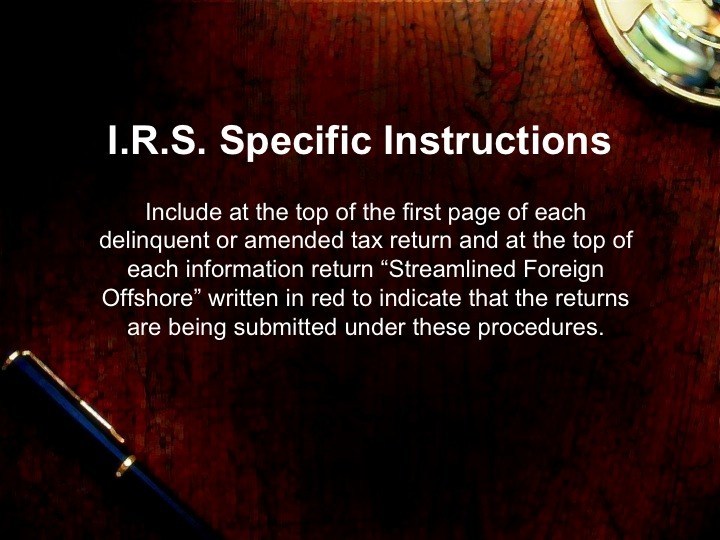
The IRS has established three separate programs under which the American taxpayer can now report foreign bank deposits that have been unreported in the past.

The Team Approach

The purpose of this article is to focus on the fact that the United States taxpayer, who is not in compliance with the Foreign Account Tax Compliance Act (“FATCA”) must understand that the appropriate way to deal with these unreported accounts is to rely on the team of both a tax lawyer and a CPA to fulfill the compliance requirements.

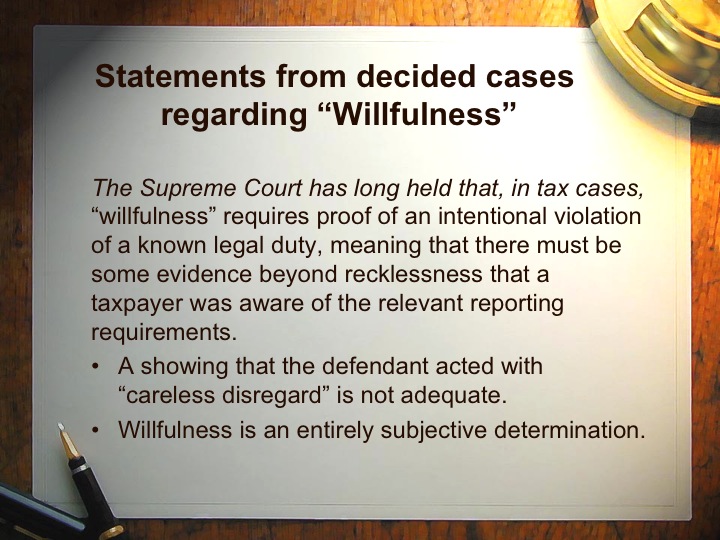
The cornerstone of determining which of the three U.S. relief programs is applicable to each taxpayer, is the determination of whether under the law a taxpayer who has not complied with the reporting requirements is either “willful” in his or her noncompliance or “non-willful”. The determination is a legal determination that has significant consequences.

The determination of which of the three relief programs offered by the IRS, is the appropriate program for the reader begins with the legal determination of whether the taxpayer is willful or non-willful. This is because in the event the taxpayer has been “willful” in their failure to file the appropriate bank reporting accounts, the taxpayer can be subject to a vast array of penalties. Even the willful taxpayer who is not in compliance to the IRS will be able to come into compliance with the United States laws and avoid the array of penalties that could very well devastate the fortunes of the “willful” taxpayer. The willful taxpayer has the chance to join one of the IRS programs.

As will also be seen, the programs not only differentiate between the willful and non-willful taxpayers. They also distinguish between the non-willful U.S. taxpayer who is a tax resident of a foreign country and U.S. taxpayers who are residents of the United States.

The team of tax lawyer, who must insure that the diagnosis of which program fits each delinquent each taxpayer is an accurate diagnosis; and the accountant is critical to success for the taxpayer. It is the tax lawyer who knows the law and who must make this initial diagnosis. It is the accountant who insures that the compliance to qualify for each program is accurate.

The Willful Definition.

The test for willfulness is whether there was a voluntary intentional violation of a known legal duty. The burden of establishing willfulness is on the Internal Revenue Service and if it is determined that the violation was due to reasonable cause, the willfulness penalty will not be asserted.

According to the IRS Manual, the innocent failure of an unsophisticated Taxpayer to know the filing requirements for international transactions, coupled with other factors, such as the lack of any efforts taken to conceal the existence of the accounts could not lead to a conclusion that the violation was due to willful blindness.

Willfulness can rarely be proved by direct evidence, since it is a state of mind. It is usually established by drawing a reasonable inference from the available facts. The I.R.S. may base a determination of willfulness in the failure to file the FBAR on inference from conduct meant to conceal sources of income or other financial information. For FBAR purposes, this could include concealing signatory authority, interest in various transactions, and interest in entities transferring cash to foreign banks.

The three separate relief programs – A brief analysis:

1. The Offshore Voluntary Disclosure Initiative

Under this program, taxpayers who are found to be willful may submit their name to the IRS in advance of making any disclosures regarding their tax issues. The IRS will then notify the taxpayer that the taxpayer’s record is clean as far as the IRS is concerned and that the taxpayer is not under examination, nor have any foreign banks reported that the taxpayer has a bank account in that bank. If the I.R.S. has prior knowledge of the taxpayer’s failure to comply, the taxpayer will not be able to enter this relief program.

Once the taxpayer has received this clearance from the IRS, the taxpayer will then be required to file eight years of amended tax returns, together with eight years of proper reports for the taxpayer’s foreign bank accounts.

The taxpayer will then be required to include in the amended tax returns any and all income not reported from the foreign bank accounts and pay the tax on such income. This tax will be subject to a 20% accuracy penalty and will, in addition, be charged with interest on unpaid taxes. The taxpayer will also be required to pay a bank deposit penalty equal to 27 ½% of the highest bank deposit balance over the eight year period.

2. The Streamlined Program – Nonresident Taxpayers

The Streamlined Program may apply to United States taxpayers who are resident outside of the United States. United States taxpayers who are tax residents outside of the United States may clear their record for their failure to file foreign bank reports in a much simpler fashion than those who are resident in the U.S. They must however be “non-willful” in their failure to file the foreign bank reports.

Non-willful taxpayers who are nonresidents outside of the United States will be permitted to enter into the Streamlined Program for nonresident taxpayers. Pursuant to the Streamlined Program, they will be required only to file three years of tax returns that should be amended to include any and all unreported income and they will be required to file FBAR reports for the prior six years. There will be no penalty assessed on foreign bank deposits of those United States taxpayers who are residents abroad.

3. Streamlined Program for Resident Taxpayers

The Streamlined Program is also open for United States taxpayers who are U.S. residents. United States taxpayers who are tax residents within the United States and are “non-willful” may clear their record for their failure to file foreign bank reports.

Non-willful taxpayers who are residents of the United States will be permitted to enter into the Streamlined Program for resident taxpayers. Pursuant to this Streamline Program, they will be required only to file three years of tax returns that should be amended to include any and all unreported income and they will be required to file FBAR reports for the prior six years. There will be a five percent penalty assessed on foreign bank deposits of those United States taxpayers.

FATCA and the Team approach

Contact Richard S. Lehman Esq.

Your Name (required)

Telephone (required)

Your Email (required)

Your Message


Enter the letters and/or numbers in the CAPTCHA code above

Posted in Domestic Taxation, IRS Amnesty, OVDP, Bank Deposits, Foreign Assets, Streamlined Compliance, Settling with the IRS Tagged with:

Tax Planning for Foreign Investors Acquiring Smaller ($500,000 and under) United States Real Estate Investments

By Richard S. Lehman, ATTORNEY AT LAW

This is principally an article about tax planning for the non resident alien individual and foreign corporate investor that is planning for smaller size investments in United States real estate (“Foreign Investor”).1

As a result of 40 years of Florida real estate experiences with foreign investors that purchase condominium units, smaller homes and many other forms of U.S. real estate investments, this article also has a few practical suggestions for the Foreign Investor.

Foreign Investors are now finding that they invest both in U.S. real estate and a strong dollar at the same time. Thus, making their investment even more valuable than ever when compared to their wealth in their own currencies. The United States real estate market is strong and growing.

However, it is important to use only a limited amount of borrowed funds. When an investor finances real state with large borrowings, the investor runs the risk of continuing to hold their real estate investments in hard times. Investment in U.S. real estate can provide significant short term profits but often will fare much better when they are viewed as long term investments.

One must seek good professionals in the United States who are also knowledgeable about the needs of the foreign investor. You must have an independent tax lawyer, real estate lawyer, an accountant a real estate broker and a property appraiser to rely on.

Tax planning for the foreign investor acquiring real estate with cash investments in the range of approximately $500,000 or less requires a look at both the U.S. income tax consequences and the U.S. estate and gift tax consequences.

Definitions of U.S. Taxes

The foreign investor will need to be concerned about three separate U.S. taxes. They are the income tax, the estate tax and the gift tax.2

There is a U.S. income tax that is applied on annual net income which starts at 15% and can be as high as 35% for both corporations and individuals. There is a tax on capital gains from the sale of assets which is only 15% to an individual taxpayer, but may be as high as 35% to a corporate taxpayer.

There is an estate tax when a non resident alien individual dies owning U.S. real estate or shares of certain types of entities that own U.S. real estate. The first $60,000 of value is excluded. Thereafter this estate tax can be as high as 45% of the equity value of the real estate.

There is also a gift tax if a non resident alien individual gifts U.S. real estate to a third party. This can be as high as the estate tax, depending upon the value of the gift.

With all of this in mind we can review the various options of U.S. real estate ownership.

1. Individual Ownership of U.S. Real Estate

An individual foreign investor may own U.S. real estate in his or her own individual name. This represents the simplest form of ownership with the least amount of paperwork involved. If it is rented out the individual owner will have to file a U.S. income tax return reporting the U.S. income.This form of ownership is only chosen by a small percentage of foreign investors. This is for at least two reasons. The first reason is liability. The owner of U.S. real estate will be personally liable for any damages that result from that real estate. While often insurance is more than sufficient to cover such claims, most investors do not want to expose themselves personally to individual liability.Furthermore, investors from many countries are fearful of revealing their wealth for security reasons. An investor’s individual name as an owner of real estate will appear in the public records where that real estate is located.This form of ownership does however provide the best income tax benefits. The individual investor will pay tax only on the investor’s U.S. income and will probably only pay a tax from operations in a relatively small tax bracket. The tax on the profit from the gain from the sale of the real estate will be only 15 to 20%. If one does choose to own U.S. real state individually, the foreign individual investor will be subject to an estate tax in the event that investor was to die owning the U.S. real estate.

2. Limited Liability Company Ownership

Foreign investors may use an entity acceptable in every state in the U.S. known as a limited liability company. This type of company is treated as if it does not exist for U.S. tax purposes and therefore the tax consequences of owning a United States limited liability company that owns U.S. real estate is similar to the tax consequences described for the individual foreign investor above.However, the big difference is that the limited liability company, as the name says, provides the investor with limited personal liability for losses related to the real estate investment.What this means is that the individual foreign investor’s personal assets are not exposed to the liabilities of the investment. This is often the best vehicle for a smaller investor in U.S. real estate. The limited liability company provides for the best income tax treatment and limited liability for the investor’s wealth.

3. The Foreign Corporation

As a general rule, it is not a good idea for a foreign investor to use a foreign corporation that will then directly invest in U.S. real estate. This is because foreign corporations that invest in U.S. real estate can be subject not only to U.S. corporate income taxes but might also be subject to a branch tax equal to 30% of the foreign corporate investors’ undistributed U.S. profits.A foreign corporation is, however, very often the investment vehicle of choice for a foreign investor that is investing significant amounts of money in U.S. real estate, such as $1 Million or more. This is because estate tax becomes a major potential liability for substantial fortunes invested in U.S. real estate and U.S. estate taxes may be completely avoided if the individual foreign investor owns a foreign corporation that may in turn own the U.S. real estate.There are no estate taxes in this situation because when the foreign investor dies, the foreign investor has only transferred to his or her heirs’ shares in the foreign corporation and there is no direct interest in U.S. real estate.

4. U.S. Domestic Corporate Ownership

The use of a United States corporation by an individual foreign investor who invests in the United States real estate is very limited by itself. That is because shares of stock in a United States corporation that owns U.S. real estate are also included in the foreign investor’s estate, if the foreign investor dies owning those shares. Thus ownership of a U.S. corporation to own U.S. real estate does not solve any U.S. estate tax problems. It does, however, create an extra tax burden for the foreign investor in United States real estate. That is because there will be an income tax on a United States corporation that earns the income as a tax on the gain for the sale of the real estate asset. Unlike the tax on an individual, which is limited to 20%, this tax can be as high as 35% when earned by a United States corporation. This can also lead to double taxation when dividends are paid to a foreign investor from the United States corporation.There are however, two situations in which investment in United States real estate by the ownership of a United States corporation does make sense. They are as follows:

Gift of Shares

First, if f the foreign investor intends to ultimately make a gift of his shares in a United States company that owns U.S. real estate to third parties, such as family members, etc., there will be no U.S. gift tax asserted on the gift of those shares. There would have been a U.S. gift tax had the real estate been given directly. Thus, the gift tax may be avoided if shares in a United States corporation are transferred prior to the foreign investor’s death. By gifting the shares the original owner will avoid the estate tax.

5. Foreign Corporation and U.S. Corporation.

Another extremely important use of a United States corporation is when it is part of a chain of corporations that ultimately owns the U.S. real estate. For example, if the foreign investor were to establish a foreign corporation that became the 100% owner of a United States corporation that owned United States real estate, the foreign investor will be able to avoid any United States estate tax completely since nothing in the U.S. is transferred in the event of the death of the foreign investor.This method of ownership is often recommended for large investments in United States real estate where the estate tax can become a major issue. It does however involve potential double taxation and other traps and tax benefits that must be individually applied.

This double tax problem can be eliminated with careful tax planning.

Term Life Insurance

There is another alternative to having the best of both worlds, which is to pay United States income taxes as an individual investor or as a limited liability company while not being concerned with the effect of United States estate taxes in the event of a premature death. That alternative is for the foreign investor to acquire sufficient “term life insurance” that pays only a death benefit for the contemplated life of the investment.

As an example, assume an investor invests one-half of One Million Dollars in United States real estate which doubles in value and is worth One Million Dollars upon the foreign investor’s death. Assume a United States estate tax of $350,000 on the value of United States real estate. The value of a $350,000 life insurance policy for say a ten year period only, of a relatively young man or woman, will not be at all prohibitive from a cost standpoint.3

One must seek good professionals in the United States who are also knowledgeable about the needs of the foreign investor. You must have an independent tax lawyer, real estate lawyer, an accountant and several property appraisers to rely on.

FOOTNOTES:

  1. See article “Tax Planning for Foreign Investors Acquiring Larger ($1,000,000 and over) United States Real Estate Investments” for a companion article on Tax Planning for Foreign Investors Acquiring Larger United States Real Estate Investments.
  2. In addition, several of the individual states in the U.S. charge their own separate income tax on income earned in that state.
  3. Another estate planning tool that allows a non resident alien investor to invest in United States real estate without incurring U.S. estate tax is the use of a Non Grantor Trust. This is a devise whereby the investor purchases the U.S. real estate using a foreign trust and foreign beneficiaries, such as family members, so that trust will ultimately benefit others. This vehicle is specifically not being discussed in this article since it does involve the investor’s alienation of the property to a trust that is extremely restrictive of any powers that the investor can have over the real estate owned by the Non Grantor Trust.

Richard S, Lehman, Esq.
TAX ATTORNEY
6018 S.W. 18th Street, Suite C-1
Boca Raton, FL 33433
Tel: 561-368-1113
Fax: 561-368-1349

Richard S. Lehman is a graduate of Georgetown Law School and obtained his Master’s degree in taxation from New York University. He has served as a law clerk to the Honorable William M. Fay, U.S. Tax Court and as Senior Attorney, Interpretative Division, Chief Counsel’s Office, Internal Revenue Service, Washington D.C. Mr. Lehman has been practicing in South Florida for more than 35 years. During Mr. Lehman’s career his tax practice has caused him to be involved in an extremely wide array of commercial transactions involving an international and domestic client base.

Posted in Foreign Investors in United States Real Estate, United States Taxation of Foreign Investors Tagged with: , , ,

Tax Planning for Foreign Investors Acquiring Larger (One Million Dollars and over) United States Real Estate Investments

This is principally an article about tax planning for the non resident alien individual and foreign corporate investor that is planning for larger size investments in United States real estate (“Foreign Investor”). That is investments of One Million Dollars ($1,000,000) or more.1

Tax Planning for Foreign Investors

Foreign Investors are now finding that they invest both in U.S. real estate and a strong dollar at the same time. Thus, making their investment even more valuable than ever when compared to their wealth in their own currencies. The United States real estate market is strong and growing.

However, it is important to use only a limited amount of borrowed funds. When an investor finances real state with large borrowings, the investor runs the risk of continuing to hold their real estate investments in hard times. Investment in U.S. real estate can provide significant short term profits but often will fare much better when they are viewed as long term investments.

One must seek good professionals in the United States who are also knowledgeable about the needs of the foreign investor. You must have an independent tax lawyer, real estate lawyer, an accountant a real estate broker and a property appraiser to rely on.

Tax planning for the foreign investor acquiring real estate with cash investments in the range of approximately $1,000,000 or more requires a look at both the U.S. income tax consequences and the U.S. estate and gift tax consequences.

Definitions of U.S. Taxes

The foreign investor will need to be concerned about three separate U.S. taxes. They are the income tax, the estate tax and the gift tax.2

There is a U.S. income tax that is applied on annual net income which starts at 15% and can be as high as 35% for both corporations and individuals. There is a tax on capital gains from the sale of assets which is only 15% to an individual taxpayer, but may be as high as 35% to a corporate taxpayer.

There is an estate tax when a non resident alien individual dies owning U.S. real estate or shares of certain types of entities that own U.S. real estate. The first $60,000 of value is excluded. Thereafter this estate tax can be as high as 45% of the equity value of the real estate.

There is also a gift tax if a non resident alien individual gifts U.S. real estate to a third party. This can be as high as the estate tax, depending upon the value of the gift.

The Individual Foreign Investor – The Problem of the Estate Tax

As a general rule, the individual foreign investor that invests in United States real estate in equity amounts of $1,000,000 or more is going to be forced to use a corporation formed outside of the United States (Foreign Corporations) somewhere in their investment structure if they are going to avoid the U.S. estate tax.

There are many exceptions to this general rule but it is still the general rule. The United States Estate tax is so onerous that the individual Foreign Investor will generally not want to assume the risk of his or her estate having to pay the United States a large tax on the death of the individual foreign owner.

The estate tax may not be a factor if one of the exceptions apply. For example, if the Foreign Investor is from a country with whom the United States has an Estate Tax Treaty, the U.S. estate tax may not apply to that foreign individual.

Furthermore, if the individual Foreign Investor is from a country that has its own high estate tax, then the U.S. estate tax may not be of concern because it can be credited against the Foreign Investor’s estate tax of his or her own country, so that there is no double estate tax.

However, for the most part, the individual Foreign Investor will have to rely on owning a Foreign Corporation as a holding company or as the direct owner of the U.S. real estate investment.

The problem with this solution to the U.S. estate tax by owning a Foreign Corporation is that in protecting the Foreign Investor from the U.S. estate tax, that Investor will generally have to pay a higher income tax from rental income that may be earned and on the ultimate sale of the assets because there is a higher tax on capital gains earned by corporations as opposed to individuals.

Term Life Insurance

Another alternative to having the best of both worlds from a U.S. tax standpoint is that an investor can pay United States income taxes as an individual investor or as a limited liability company while not being concerned with the effect of United States estate taxes in the event of a premature death by buying life insurance equal to the potential U.S. estate tax exposure. That alternative is for the Foreign Investor to acquire sufficient “term life insurance” that pays only a death benefit for the contemplated life of the investment. Depending upon the age of the investors, this may be an inexpensive solution.

As an example, assume an investor invests one-half of One Million Dollars in United States real estate which doubles in value and is still held by the Foreign Investor but worth One Million Dollars upon the foreign investor’s death. Assume a United States estate tax of $350,000 on the value of United States real estate. The annual cost of a $350,000 life insurance policy for say a ten year period only, of a relatively young man or woman, will not be at all prohibitive from a cost standpoint.

Income and Capital Gains Tax

With all of this in mind we can review the various options of U.S. real estate ownership by the larger Foreign Investor.

1. Individual Ownership of U.S. Real Estate.

An individual Foreign Investor may own U.S. real estate in his or her own individual name. This represents the simplest form of ownership with the least amount of paperwork involved. If it is rented out the individual owner will have to file a U.S. income tax return personally reporting the U.S. income.

This form of ownership is only chosen by a small percentage of Foreign Investors. This is for at least two reasons. The first reason is liability. The owner of U.S. real estate will be personally liable for any damages that result from that real estate. While often insurance is more than sufficient to cover such claims, most investors do not want to expose themselves personally to individual liability.

Furthermore, investors from many countries are fearful of revealing their wealth for security reasons, particularly if it is a large investment. An investor’s individual name as an owner of U.S. real estate will appear in the public records where that real estate is located.

This form of ownership does however provide the best income tax benefits. The individual investor will pay tax only on the investor’s U.S. income. Because of expenses and depreciation deductions, the Investor may only pay a tax from operations in a relatively small tax bracket.

The tax on the profit from the gain from the sale of the real estate will be only 15% to 20%.

If one does choose to own U.S. real state individually, the foreign individual investor may be subject to an estate tax in the event that investor was to die owning the U.S. real estate.

2. Limited Liability Company Ownership.

Foreign Investors may use an entity acceptable in every state in the U.S. known as a limited liability company. This type of company is treated as if it does not exist for U.S. tax purposes and therefore the tax consequences of owning a United States limited liability company that owns U.S. real estate is similar to the tax consequences described for the individual foreign investor above. A U.S. estate tax will apply to U.S. real estate owned by a limited liability company.

However, the big difference is that the limited liability company, as the name says, provides the investor with limited personal liability for losses related to the real estate investment.

What this means is that the individual foreign investor’s personal assets are not exposed to the liabilities of the investment. The limited liability company provides for the best income tax treatment and limited liability for the investor’s wealth.

3. U.S. Domestic Corporate Ownership.

The use of a United States corporation by an individual Foreign Investor who invests in the United States real estate is very limited by itself. That is because shares of stock in a United States corporation that owns U.S. real estate are also included in the foreign investor’s estate, if the foreign investor dies owning those shares. Thus ownership of a U.S. corporation to own U.S. real estate does not solve any U.S. estate tax problems. It does, however, create an extra tax burden for the foreign investor in United States real estate. That is because there will be an income tax on a United States corporation on the gain of the sale of the real estate asset that can be higher than the tax on the foreign individual investor. Unlike the tax on an individual, which is limited to 20%, the corporate tax can be as high as 35%.

There is however, one situation in which investment in United States real estate by the ownership of a United States corporation does make sense. It is as follows:

Gift of Shares

If the individual foreign investor intends to ultimately make a gift of his or her shares in a United States company that owns U.S. real estate to third parties, such as family members, etc., there will be no U.S. gift tax asserted on the gift of those shares. There would have been a U.S. gift tax had the real estate been given directly. Thus, the estate tax may be avoided with no gift tax payable if shares in a United States corporation that owns U.S. real estate are transferred prior to the foreign investor’s death.

4. The Foreign Corporation.

As a general rule, it is not a good idea for a foreign investor to use a foreign corporation that will then directly invest in U.S. real estate. This is because foreign corporations that invest in U.S. real estate can be subject not only to U.S. corporate income taxes but might also be subject to a branch tax equal to 30% of the foreign corporate investors’ undistributed U.S. profits.

A foreign corporation is, nevertheless, very often the investment vehicle of choice for a foreign investor that is investing significant amounts of money in U.S. real estate, such as $1 Million or more. This is because estate tax becomes a major potential liability for substantial fortunes invested in U.S. real estate and U.S. estate taxes may be completely avoided if the individual Foreign Investor owns a foreign corporation that may in turn own the U.S. real estate.

There are no estate taxes in this situation because when the Foreign Investor dies owning the U.S. real estate indirectly, the Foreign Investor only transfers to his or her beneficiaries, shares in the foreign corporation and there is no direct transfer of an interest in U.S. real estate.

This more complicated structure, in knowledgeable hands permits many tax planning opportunities.

U.S. estate taxes may be completely avoided if the individual Foreign Investor owns a foreign corporation that may in turn own the U.S. real estate.

5. Foreign Corporations and U.S. Corporations.

A more typical structure for a large investment in U.S. real estate is for the individual Foreign Investor to establish a 100% owned Foreign Corporation that becomes the 100% owner of a United States corporation that ultimately owns the U.S. real estate. For example, if the Foreign Investor were to establish a foreign corporation that became the 100% owner of a United States corporation that owned United States real estate, the Foreign Investor will be able to avoid any United States estate tax completely since nothing in the U.S. is transferred in the event of the death of the Foreign Investor.

The Tax Planning Opportunities

The more complicated structure of establishing a Foreign Corporation that owns a U.S. corporation that owns larger U.S. real estate investments provides several opportunities for income tax planning.

Liquidation of Company

The principal tax planning tool of the use of the Foreign Corporation that owns a U.S. corporation to own its U.S. real estate is to make sure that when the United States real estate is sold by the U.S. Corporation, that U.S. Corporation must be liquidated after the sale. In this fashion only one single U.S. tax is paid at the U.S. corporation level. The proceeds of sale may be transferred free of tax by the U.S. corporation after it has paid its U.S. tax if it is liquidated after the sale.3

Portfolio Loans

Another often used tax planning tool is known as the “Portfolio Loan”. As a general rule a Foreign Corporation or a U.S. Corporation that owns U.S. real estate will be able to deduct as a business deduction all of the expenses of that ownership, which include the payment of interest on loans made to acquire the real estate. As a general rule, loans made by a Foreign Investor to his or her own Foreign Company, U.S. Company or Limited Liability Company will be deductible by the company. However, the payment of such interest to the Foreign Owner of the company may be subject to a tax as high as 30% on the gross interest paid to the investing company’s foreign shareholder.

There is, however, a major exception to this general rule provided in the Internal Revenue Code. That is that a Foreign Investor who owns less than 10% of the real estate investment will be able to receive the interest that is deductible by the Foreign Company free of any U.S. tax whatsoever. This rule does not work in the event the investor owns 10% or more of the real estate investment or the entity that owns that real estate investment.

However, it is a useful planning tool in many situations where more than one investor is involved. In those situations where a portfolio loan can be used, the U.S. taxes on the income earned from the real estate investment will be reduced for the interest expense payable to the Foreign Investor without the payment of tax on that interest.

“. . . the U.S. taxes on the income earned from the real estate investment will be reduced for the interest expense payable to the Foreign Investor…

Portfolio Loan Sales

There is another way to take advantage of the Portfolio Loan exclusion for interest paid to Foreign Investors. This can be accomplished at the actual time of sale by a Foreign Investor of his or her U.S. investment. To understand this, it is important to keep in mind that the portfolio interest deduction and exclusion from income is only appropriate if the Foreign Investor no longer has a 10% or less interest in the property.

Therefore a Foreign Seller may wish to sell the property, not for all cash but rather for cash and the balance due in the form of a note payable by the U.S. Buyer to the Foreign Seller who no longer owns any part of the U.S. real estate. At that point the Foreign Seller will be receiving tax free interest from the note that the Foreign Seller holds as a result of the U.S. real estate and the property can be used to secure the note until its full payment. This method of converting what otherwise might be taxable sales proceeds into tax free interest income could be of significant tax value under the right circumstances.

Like Kind Exchanges

Another method used by both Foreigners and Americans alike to grow their U.S. real estate portfolios free of U.S. tax is to make use of the “Like Kind Exchange Rules”. Essentially these rules hold that an investor in U.S. real estate may exchange the U.S. real estate project that they own for a different U.S. real estate project without paying any immediate tax on any gain or profit that may be accrued in the first investment.

For example, assume a Brazilian investor owns a U.S. corporation which owns raw land that the investor purchased for $ 3 Million. Assume the raw land is now worth $6 Million and the investor wishes to terminate his investment in the raw land and instead own an income producing asset such as a shopping center. Assume the shopping center is worth $ 6 Million.

Even though the raw land has increased in the amount of $ 3 Million, none of that gain will be recognized or will it become taxable until the Corporation actually sells the real estate that it has acquired as part of the exchange. At that point the investor’s investment in the shopping center has its original cost of $3 Million and any gain over and above that would be taxable if the shopping center were later sold.

… selling shares of a foreign corporation would result in no tax whatsoever being paid by the foreign entity trust on the shares of these stock.

Sale of Stock in a Foreign Corporation

In addition, on rare occasions, it has been possible for foreign investors to sell their shares in the Foreign Corporation that owns U.S. real estate to a third party buyer. It is clearly understood that selling shares of a corporation that owns real estate, instead of the actual real estate is not typical. However, this transaction, of a foreign entity selling shares of a foreign corporation would result in no tax whatsoever being paid by the foreign entity trust on the shares of these stock. There is a market for such transaction in the U.S. in specialized cases.4

FOOTNOTES:

  1. See article “Tax Planning for Foreign Investors Acquiring Smaller ($500,000 and under) United States Real Estate Investments” for a companion article on Tax Planning for Foreign Investors Acquiring Smaller United States Real Estate Investments.
  2. In addition, several of the individual states in the U.S. charge their own separate income tax on income earned in that state.
  3. Often one Foreign Corporation may be used as a holding company and will set up several U.S. corporations to own different projects. That way each U.S. Corporation may be liquidated on a deal by deal basis, leaving the Foreign Corporation in place.
  4. Another estate planning tool that allows a non resident alien investor to invest in United States real estate without incurring U.S. estate tax is the use of a Non Grantor Trust. This is a devise whereby the investor purchases the U.S. real estate using a foreign trust and foreign beneficiaries, such as family members, so that trust will ultimately benefit others. This vehicle is specifically not being discussed in this article since it does involve the investor’s alienation of the property to a trust that is extremely restrictive of any powers that the investor can have over the real estate owned by the Non Grantor Trust.

Richard S, Lehman, Esq.
TAX ATTORNEY
6018 S.W. 18th Street, Suite C-1
Boca Raton, FL 33433
Tel: 561-368-1113
Fax: 561-368-1349

Richard S. Lehman is a graduate of Georgetown Law School and obtained his Master’s degree in taxation from New York University. He has served as a law clerk to the Honorable William M. Fay, U.S. Tax Court and as Senior Attorney, Interpretative Division, Chief Counsel’s Office, Internal Revenue Service, Washington D.C. Mr. Lehman has been practicing in South Florida for more than 35 years. During Mr. Lehman’s career his tax practice has caused him to be involved in an extremely wide array of commercial transactions involving an international and domestic client base.

Contact Richard S. Lehman Esq., Today.

Your Name (required)

Your Email (required)

Phone (required)

Your Message


Enter the letters and/or numbers in the CAPTCHA code above

Posted in Foreign Investors in United States Real Estate, United States Taxation of Foreign Investors Tagged with: , , , , , ,

IC-DISC and United States Exporting of Computer Software, Internet Sales and Licenses

Export Property

These are frequently asked questions on the topic of the IC-DISC as a major tax saving tool. These answers are from Richard S. Lehman Esq.

Question 1: Will a customer of company that is exporting through a DISC know that there is a DISC involved in the transaction?

Answer : The existence of the DISC will be transparent to the export company’s customers. The exporter will continue to operate its business in the same manner and its employees will continue to perform the company’s manufacturing, sales, billing, shipping and collection functions. The fact that there is a commission agreement between the exporter and the DISC will not have to be disclosed to the exporter’s customers and no documentation provided to the customers will need to indicate the existence of or services deemed provided by the DISC.

Question 2: What is the definition of “Export Property” that will qualify for DISC treatment?

Answer: Export property means property: Manufactured, produced, grown or extracted in the United States; held for sale, lease or rental, in the ordinary course of business, for use, consumption or disposition outside the United States; and Not more than 50% of the fair market value of which is attributed to articles imported into the United States.

Question 3: What are the requirements to establish a DISC corporation?

Answer:

  1. 1A corporation taxable as a corporation must be formed under the laws of any State or the District of Columbia to be the IC-DISC.
  2. The corporation must have only one class of stock and minimum capital of $2,500. The IC-DISC shareholders may be related to the IC-DISC.
  3. The IC-DISC must take a tax election to be an IC-DISC that must be filed with the Internal Revenue Service within 90 days after the beginning of the tax year of the IC-DISC.
  4. The IC-DISC must maintain separate books and records.
  5. The IC-DISC must have at least 95% or more of its gross receipts considered to be Qualified Receipts resulting from the DISC’s export activities. The transaction must be pursuant to the terms of a contract entered into with a purchaser by the DISC or by the principal at any time or by any other person and assigned to the DISC or the principal at any time prior to the shipment of such property to the purchaser.
  6. The IC-DISC must have at least 95% or more of its assets considered to be Qualified Export Receipts.

Question 4: What are the tax benefits to be gained by using a DISC?

Answer: The tax benefits of the IC-DISC come in two separate fashions. The IC-DISC shareholders may leave the IC-DISC profits in the IC-DISC and defer taxation until actual distribution of the profits or the IC-DISC may distribute profits to its shareholders like any other corporation. Since IC-DISC distributions are considered “qualified dividends”, they are subject to a maximum tax of 20%. Thus the magic of the IC-DISC is to provide both tax deferral and to apply a 20% maximum dividend tax rate to profits that would otherwise be taxable in the U.S. taxpayer’s highest brackets that can range as high as 50% when city, state and federal income taxes are calculated.

Question 5: What methods of pricing may be used to determine the amount that can be paid to a DISC?

Answer:

Gross Receipts Methods.

Under the gross receipts method of pricing, the transfer price for a sale by the related supplier to the DISC is the price as a result of which the taxable income derived by the DISC form the sale will not exceed the sum of (i) 4 percent of the qualified export receipts of the DISC derived from the sale of the export property and (ii) 10 percent of the export promotion expenses of the DISC attributable to such qualified export receipts.

Taxable Income Method.

Under the combined taxable income method of pricing, the transfer price for a sale by the related supplier to the DISC is the price as a result of which the taxable income derived by the DISC from the sale will not exceed the sum of (i) 50 percent of the combined taxable income of the DISC and its related supplier attributable to the qualified export receipts form such sale and (ii) 10 percent of the export promotion expenses of the DISC attributable to such qualified export receipts.

Arm’s Length Method.

If the rules of the preceding paragraphs are inapplicable to a sale or a taxpayer does not choose to use them, the transfer price for a sale by the related supplier to the DISC is to be determined on the basis of the sale price actually charged but subject to the rules provided by the rules of sale between related parties.


The Export Disc Corporation Computer Software And Internet Sales And Licenses

By Richard S. Lehman, Esq

The IC-DISC has been approved as an acceptable tax planning entity for the export of American produced computer software and programs as early as 1985. In 1998, a very detailed set of Treasury Regulations were issued that have added certainty to this area of the law.

Before the issuance of the Software Regulations, there was uncertainty about the taxation of computer program transactions. Computer programs did not fit traditional tax principles. Computer programs are usually sold pursuant to “license” or “user agreements”. A computer program transaction is unlike a sale of a physical object since the value of the program copy far exceeds the value of the physical medium on which it is transferred. Computer programs, in fact are transferred electronically. Often, there is no physical medium at all.

For purposes of determining the applicability of the DISC to computer software exports, two key analyses are often required. First, (1) is the software “export property” for DISC purposes and (2) is the software product’s source of income “from without the U.S.”? Is the product for use, consumption or sale without the U.S.?

In a technical advice memorandum in 1985, the I.R.S. issued guidance on the issue of whether certain computer software programs constituted “export property” for DISC purposes. That Technical Advice Memorandum reviewed the term “export property” for DISC purposes in depth and determined in its holding that computer software could indeed be “export property”. In doing so the Technical Advice not only reviewed the legislative history of the DISC rules it also pointed out the distinctively different treatment that “patents, inventions, models, decisions, formulas, or processes whether or not patented, copyrights, goodwill, trademarks, trade brands, franchise or other like property” receive under the DISC rules, as opposed to the treatment of “films, tapes, records or similar reproductions, for commercial or home use.”

Copyright law is the basis for the Software Regulations. The Regulations are based on the concept that it is possible to categorize a computer program transaction by analyzing the copyright rights transferred. Like many other tax laws, it is generally accepted that the taxation of payments made pursuant to a contract is determined based on an analysis of the contract’s substance, without regard to the labels.

The most important distinction created by the Software Regulations is the distinction between copyrighted articles and copyright rights. This basic distinction arises from copyright law. Copyright law distinguishes between the copyright itself, which grants the owner certain rights, and a copy of the copyrighted work. The Copyright Act grants to copyright owners the exclusive right to “reproduce the copyrighted work in copies”. The Copyright Act states that “Ownership of a copyright, or of any of the exclusive rights under a copyright, is distinct from ownership of any material object in which the work is embedded.”

The Copyright Rights are not “export property” for DISC purposes while the Copyright Articles are “export property”.

The “Export Property” analysis in the I.R.S. Technical Advice Memorandum is enlightening.

The computer software considered as an example to show the nature of “Computer Articles” was described in the Technical Advice Memorandum as follows:

Mr. X develops, markets and services standardized computer software on a worldwide basis. The software consists of computer programs on magnetic tape. Computer programs are coded instructions to operate the computer to process data in a specified manner.

Mr. X’s computer software products are manufactured in the following manner. Computer programmers develop a computer program, which is referred to as “source language software” (“source code”). The source code is highly confidential and kept under strictly controlled security at all times. The modifications to the computer programs that are required to keep the software up to date with changing technology and user requirements are made to the source code. The source code is processed by a computer into a master recording, which contains the magnetic impulses a customer will receive. Unlike the source code, the master recording cannot be used to modify a software program. The products that Mr. X markets are tapes made from the master recordings.

The Export Property Analysis

Export property is defined to mean, in general, property that is:

  1. Manufactured, produced, grown or extracted in the United States by a person other than a DISC,
  2. Held primarily for sale, lease, or rental, in the ordinary course of trade or business, by, or to, a DISC, for direct use, consumption, or disposition outside the United States and
  3. Not more than 50 percent of the fair market value of which is attributable to articles imported into the United States.

Export property does not include “patents, inventions, models, designs, formulas, or processes, whether or not patented, copyrights (other than films, tapes, records, or similar reproductions, for commercial or home use), good will, trademarks, trade brands, franchises, or other like property . . .

Although a copyright such as a copyright on a book does not constitute export property, a copyrighted article (such as a book) if not accompanied by a right to reproduce it is export property. The legislative history of the DISC states the following: “Although generally the sale or license of a copyright does not produce qualified export receipts (since a copyright is generally not export property), the sale or lease of a copyrighted book, record, or other articles does generally produce qualified export receipts”.

Computer software can be export property. Computer software tapes are akin to the copyrighted books, which qualify as export property. Computer programs are standardized programs that are manufactured in the United States by a person other than a DISC and then marketed outside the United States. This is not selling the source code or master recording. Those purchasing or leasing programs do not have the right to reproduce the software.


Copyright Rights

The regulations distinguish between transfers of copyright rights and transfers of copyrighted articles based on the type of rights transferred to the transferee. The transfer is classified as a transfer of a copyright if, as a result of a transaction, a person acquires any one or more of the following rights:

(1) the right to make copies of the computer program for purposes of distribution to the public by sale or other transfer of ownership, or by rental, lease or lending;

(2) the right to prepare derivative computer programs based on the copyrighted computer program;

(3) the right to make a public performance of the computer program; or

(4) the right to publicly display the computer program.

Transfers of Computer Programs

The regulations provide rules for classifying transactions involving the transfer of computer programs. A computer program includes any media, user manuals, documentation, database or similar item if the media user manuals, documentation, database or similar item is incidental to the operation of the computer program.

A copyrighted article is defined as a copy of a computer program from which the work can be perceived, reproduced, or otherwise communicated, either directly or with the aid of a machine or device. If a person acquires a copy of a computer program but does not acquire any of the four copyright rights, the transfer is classified as a transfer of a copyrighted article.

In general, a transfer of a computer program is classified in one of the following ways.

  1. A sale or exchange of the legal rights constituting a copyright (which generates income sourced according to the rules for sales of personal property);
  2. A license of a copyright (which generates royalty income);
  3. A sale or exchange of a copyright article produced under a copyright (which generates income sourced according to the rules for sales of personal property);
  4. A lease of a copyright article produced under a copyright (which generates rental income).1

1Additional rules allow for the classification of a transfer as partially a transfer of services or of know-how. The provision of know-how, in which the transferor retains continuing use of the know how transferred, is presumably most like a license of a copyright.

The following are four examples from the Treasury Regulations that describe the four types of transactions.

Example 1 – Sale of Copyright Article

A U.S. corporation, (the “U.S. corporation”) owns the copyright in a computer program, (the “Program”).

The U.S. corporation, (the “U.S. Corporation”), makes the Program available, for a fee, on a World Wide Web home page on the Internet. Mr. P, a resident of Country Z, in return for payment to the U.S. Corporation, downloads the Program X (via modem) onto the hard drive of his computer. As part of the electronic communications, P signifies his assent to a license agreement.

Mr. P receives the right to use the program on his own computers (for example, a laptop and a desktop). None of the copyright rights have been transferred in this transaction. P has received a copy of the Program. P has acquired solely a copyrighted article.

P is properly treated as the owner of a copyrighted article. There has been a sale of a copyrighted article rather than the grant of a lease.

Example 2

The facts are the same as those in Example 1, except that the U.S. Corporation only allows Mr. P, the right to use the Program for one week. If P wishes to use the Program for a further period he must enter into a new agreement to use the program for an additional charge.

P is not properly treated as the owner of a copyrighted article. There has been a lease of a copyrighted article rather than a sale.

Example 3

A U.S. Corporation, transfers a disk containing the Program to a Foreign Corporation (the “Foreign Corporation”) and grants the Foreign Corporation an exclusive license for the remaining term of the copyright to copy and distribute an unlimited number of copies of the Program in the geographic area of the Country in which the Foreign Corporation makes public performances of the Program and publicly displays the Program.

Applying the all substantial rights test, the U.S. Corporation will be treated as having sold copyright rights to the Foreign Corporation. The Foreign Corporation has acquired all of the copyright rights in the Program and has received the right to use them exclusively within the Foreign Country.

Example 4

A U.S. corporation, transfers a disk containing the Program to a Foreign Corporation in Country X and grants the Foreign Corporation the non exclusive right to reproduce (either directly or by contracting with another person to do so) and distribute for sale to the public an unlimited number of disks at its factory in return for a payment related to the number of disks copied and sold. The term of the agreement is two years, which is less than the remaining life of the copyright.

There is a lease of copyright rights since copyright right have been assigned but for a limited time period only.


The Source of Income Analysis

Once it is determined that a computer program is a copyright article and thus “export property” for DISC purposes; then the issue is to determine whether the Software Program is being sold for use, consumption of disposition outside of the U.S. This analysis depends upon the “source of income” rules.

Generally under the current rules, the source of income from sales of property depends to varying extents upon both the type of property and whether the property sold or leased is “inventory property”.

Income from the lease of a copyright article must also fit this definition of non U.S. source of income.

The user of the computer program is particularly important in the international context. Income earned from commerce between countries must be assigned a source under rules. This requires a determination of whether the transaction is a sale of inventory, a rental of property, a license or sale of intellectual property or the provision of services.

The regulations focus on (i) acknowledging the special circumstances of computer programs, (ii) distinguishing between transactions in copyright rights and in copyrighted articles, and (iii) focusing on the economic substance of the transaction over the labels applied, the form and the delivery mechanism.

The Software Regulations provide explicit guidance on how to source income arising from transactions categorized under the regulations by cross referencing existing source rules.

The regulations provide that income from transactions that are classified as sales or exchanges of copyrighted articles will be sourced under the sections of Internal Revenue Code that determine if income is earned in the United States for tax purposes or earned outside of the United States. Income from the leasing of a computer program will be sourced under different Internal Revenue Code sections.

Source of Income for Sales of Copyrighted Articles

A transfer of intangible property is a sale if the actual facts and circumstances support the fact that the transferor has transferred “all substantial rights” to the computer software property. A perpetual and exclusive license of intangible property is considered to be a transfer of “all substantial rights” is also treated as a sale, rather than as a license, for tax purposes. All the facts and circumstances are reviewed to determine whether the transaction transferred “all substantial rights” to the property in question.

A sale of a copyrighted article occurs if sufficient benefits and burdens of ownership have been transferred to the buyer, taking into account all facts and circumstances. This is the same test that generally is applied to determine whether transfers of tangible personal property are sales or leases.

The source of income generated by the sale or exchange of a copyrighted article often depends upon whether the sale took place within or without the United States. The Software Regulations provide that the place of sale is determined under the “title passage rule”.

The governing regulation state that “a sale of personal property is consummated at the time when and the place where, the rights, title and interest of the seller in the property are transferred to the buyer”. The sale shall be deemed to have occurred at the time and place of passage to the buyer of beneficial ownership and the risk of loss.

As to the issue of determining the place of sale under the title passage rule, the parties in many cases can agree on where title passes for sales of inventory property generally.


Application of the Title Passage Rule

As described above, the source of income generated by the sale or exchange of a copyrighted article often depends upon whether the sale took place within or without the United States. The place of sale is determined under the title passage rule. The Software Regulations recognizes that typical license agreements do not refer to a transfer of property and an electronic transfer is generally not accompanied by the usual indicia of the transfer of title.

Application of the Title Passage Rule

There are important categories of copyrighted article transfers for DISC purposes: (i) a transfer of tangible property, such as a tangible medium in which the copyrighted article is embodied, and/or a hard copy of user manuals and documentation; (ii) (e.g., electronically transmitted copyrighted articles without any hard copy of user manuals and documentation). Either one of these can be the subject of a sale.

To comply with the passage of title rules, a DISC may consider language such as: Title to this computer software program, shall pass outside the United States in its agreements when tangible property is being transferred. If non tangible property is delivered, the DISC taxpayers could consider documentation for foreign users (which could be a contract to sign or terms consented to electronically) that states that the vendor’s delivery obligation shall be complete and risk of loss with respect to the copyrighted article shall pass at the time the program is copied onto the recipient’s computer at the end user’s location.

Partial Transfer of a Copyright Article: A Lease

If less than all of the benefits and burdens associated with a copyrighted article have passed to the transferee, the Software Regulations treat the transaction as a lease. Copyright articles can be leased as well as sold. Computer programs do not involve the risk of physical deterioration or physical destruction but they do have the risk of technological obsolescence. If this risk is assumed by the transferee, generally through a transaction in which the transferee makes a single payment in return for the right to use the program copy in perpetuity, then the transferee has assumed the risk of obsolescence and should be treated as the owner of the program copy.

However, if the transferee instead makes periodic payment and can cease its use of the program when it chooses, then the transferee has not assumed the relevant benefits and burdens of ownership and the transaction should be considered a lease.

Lease and Rental Source of Income

Under the Software Regulations, income derived from the rental of a copyrighted article is sourced under Section 861(a)(4) and 862(a)(4). As a general rule, rents and royalties are sourced to the place where the leased or licensed property is located, or where the lessee or licensee uses, or is entitled to use the property.

Leased property is used where it is physically located at the time of its use by the lessee. Therefore a computer program copy that is “rented” under a limited duration license should be considered to be used at the place where the computer that hosts the program is physically located while the lessee uses the program. If the copy resides on the lessee’s computer, the lessor will need to know where that computer is located in order to source its rental income.

If you have additional questions, please contact us today. Value can be lost without good legal advice.

Your Name (required)

Telephone (required)

Your Email (required)

AREA OF INTEREST:

Your Message


Enter the letters and/or numbers in the CAPTCHA code above

Posted in Exporting Tax Benefits The IC-DISC Tagged with: , , , , , , , , , , , , ,

The New IRS Streamlined Filing Compliance Procedures

Here are frequently asked questions about the IRS changes to the Offshore Bank and Foreign Asset Disclosure Programs.

Question 1. Will a taxpayer qualify for either of the Streamline Program or the Offshore Voluntary Disclosure Program that permits Taxpayers to voluntarily disclose their offshore bank accounts with reduced penalties if they are under examination?

Answer: Taxpayers who are already under a civil examination of a taxpayer’s returns for any taxable year, (regardless of whether the examination related to undisclosed foreign financial assets), will not be eligible to use the streamlined procedures or the Offshore Voluntary Program. Taxpayers under examination may consult with their agent. Similarly, a taxpayer under criminal investigation by IRS Criminal Investigation is also ineligible to use the streamlined procedures.

Question 2. What are the requirements that a U.S. Taxpayer who is living in the U.S. must meet for the Streamlined Disclosure Program?

Answer:

  1. The taxpayer must be a U.S. tax resident in the U.S. (for joint return filers, one or both of the spouses must be tax residents.
  2. The taxpayer must have previously filed a U.S. tax return (if required) for each of the most recent 3 years for which the U.S. tax return due date (or properly applied for extended due date) has passed.
  3. The taxpayer must have failed to report gross income from a foreign financial asset and pay tax as required by U.S. law, and may have failed to file an FBAR and/or one or more international information returns, such as forms reporting gifts from foreign persons, forms for U.S. taxpayers that have ownership in foreign corporations and forms disclosing all of the taxpayers foreign income producing assets.
  4. Such failures must have resulted from non willful conduct. Non willful conduct is conduct that is due to negligence, inadvertence, or mistake or conduct that is the result of a good faith misunderstanding of the requirement of the law.

Total Presentation Time: 30 minutes


PODCAST (audio only)


I.R.S. Makes Changes To Offshore Bank And Foreign Asset Disclosure Programs

By Richard S. Lehman, Tax Attorney

The Internal Revenue Service announced major changes in its offshore voluntary compliance programs, providing new options to help both taxpayers residing overseas and those residing in the United States. These changes will provide thousands of people a new avenue to come into compliance with their U.S. tax obligations. The expanded streamlined procedures are intended for U.S. taxpayers whose failure to disclose their offshore assets are non willful.

This is an extremely important and valuable I.R.S. Program. It allows almost every American who has been afraid to step forward and disclose their foreign assets to the U.S. taxing authorities to do so with minimized penalties on unpaid taxes and unfiled information returns.

Purpose of the streamlined procedures: The streamlined filing compliance procedures are available to taxpayers certifying that their failure to report foreign financial assets and pay all tax due in respect of those assets did not result from willful conduct on their part. The streamlined procedures are designed to provide to taxpayers in such situations:

  1. a streamlined procedure for filing amended or delinquent returns and
  2. terms for resolving their tax and penalty obligations. These procedures will be available for an indefinite period until otherwise announced. This means that just as the Internal Revenue Service has suddenly announced this highly beneficial “settlement tool”, the Internal Revenue Service can withdraw the program. Eligible taxpayers need to act quickly.

General eligibility for the streamlined procedures: The streamlined filing compliance procedures, (the “Streamlined Procedures”), are designed for only individual taxpayers, including estates of individual taxpayers. The Streamlined Procedures are available to both U.S. individual taxpayers residing outside the United States and U.S. individual taxpayers residing in the United States.

Taxpayers using either the Streamlined Foreign Offshore Procedures or the Streamlined Domestic Offshore Procedures will be required to certify, in accordance with the specific instructions set forth below, that the failure to report all income, pay all tax and submit all required information returns, including FBARs, was due to non willful conduct.

Audit of Returns

Taxpayers who choose the “Streamlined Procedures” to report offshore income will not be able to enter the existing I.R.S. Offshore Voluntary Disclosure Program (OVDP).

Most important, taxpayers who choose this Streamlined Procedure must be sure their disclosures are complete and in good faith. This is because returns submitted under the Streamlined Procedures will not be subject to IRS audit automatically. However, they may be selected for audit under the existing audit selection processes applicable to any U.S. tax return and may also be subject to verification procedures in that the accuracy and completeness of submissions may be checked against information received from banks, financial advisors, and other sources.

Thus, returns submitted under the streamlined procedures may be subject to IRS examination, additional civil penalties and even criminal liability, if appropriate.

Not Eligible

Not all taxpayers will be eligible for the streamlined procedures.

Taxpayers who are already under a civil examination of a taxpayer’s returns for any taxable year, (regardless of whether the examination relates to undisclosed foreign financial assets), will not be eligible to use the streamlined procedures. Taxpayers under examination may consult with their agent. Similarly, a taxpayer under criminal investigation by IRS Criminal Investigation is also ineligible to use the streamlined procedures.

Quiet Disclosures

Taxpayers eligible to use the Streamlined Procedures who have previously filed delinquent or amended returns in an attempt to address U.S. tax and information reporting obligations with respect to foreign financial assets (so called “Quiet disclosures”) may still use the streamlined procedures. However, any penalty assessments previously made with respect to those filings will not be abated.

Receipt of the returns will not be acknowledged by the IRS and the streamlined filing process will not culminate in the signing of a closing agreement with the IRS. However, the check will be cashed. No formal confirmation of acceptance will be provided by the I.R.S.

The Offshore Voluntary Disclosure Program

If a Taxpayer is concerned that his or her failure to report income, pay tax and submit required information returns was due to willful conduct and who wants more assurances that they will not be subject to criminal inability and/or substantial monetary penalties, that taxpayer should consider participating in the Offshore Voluntary Disclosure Program (OVDP) and should consult with their professional tax or legal advisers.

This Offshore Voluntary Compliance Program is a separate I.R.S. Program that waives certain serious penalties but asserts a much higher overall penalty than the Streamlined Procedure and it assures taxpayers that they will have a perfectly clean slate.

Coordination with treatment under OVDP

Once a taxpayer makes a submission under either the Streamlined Foreign Offshore Procedures of the Streamlined Domestic Offshore Procedures, the taxpayer may not participate in OVDP.

Similarly, a taxpayer who submits an OVDP voluntary disclosure letter on or after July 1, 2014, is not eligible to participate in the streamlined procedures.
A taxpayer eligible for treatment under the Streamlined Procedures who submits, or has submitted, a voluntary disclosure letter under the OVDP (or any predecessor offshore voluntary disclosure program) prior to July 1, 2014, but who does not yet have a fully executed OVDP voluntary disclosure letter on or after July 1, 2014, is eligible to participate in the streamlined procedures.

The Streamlined Procedures will apply to all United States taxpayers that are residing both within and without the United States. The rules are slightly different for U.S. taxpayers who reside without the United States.

Eligibility Procedures and requirements are for these taxpayers.

U.S. TAXPAYERS RESIDING IN THE UNITED STATES

U.S. Residents

  1. The taxpayer must be a U.S. tax resident in the U.S. (for joint return filers, one or both of the spouses must be tax residents.
  2. The taxpayer must have previously filed a U.S. tax return (if required) for each of the most recent 3 years for which the U.S. tax return due date (or properly applied for extended due date) has passed;
  3. The taxpayer must have failed to report gross income from a foreign financial asset and pay tax as required by U.S. law, and may have failed to file an FBAR and or one or more international information returns, such as forms reporting gifts from foreign persons, forms for U.S. taxpayers that have ownership in foreign corporations and forms disclosing all of the taxpayers foreign income producing assets.
  4. Such failures must have resulted from non willful conduct. Non willful conduct is conduct that is due to negligence, inadvertence, or mistake or conduct that is the result of a good faith misunderstanding of the requirements of the law.

The test for willfulness is whether there was a voluntary, intentional violation of a known legal duty. A finding of willfulness must be supported by evidence of willfulness. The burden of establishing willfulness is on the Internal Revenue Service and if it is determined that the violation was due to reasonable cause, the willfulness penalty should not be asserted.

Streamlined Filing Compliance Procedures

The Benefits Of The Streamlined Procedure

A taxpayer who is eligible to use these Streamlined Foreign Offshore Procedures and who complies with all of the instructions will not be subject to failure to file and failure to pay penalties, accuracy related penalties, information return penalties, or FBAR penalties.

Specific Instructions for the Streamlined Foreign Offshore Procedures

Failure to follow these instructions or to submit the items described below will result in returns being processed in the normal course without the benefit of the favorable terms of these procedures.

  1. For each of the most recent 3 years for which the U.S. tax return due date (or properly applied for extended due date) has passed: If a U.S. tax return has been filed previously, submit a complete and accurate amended tax return using Form 1040X, Amended U.S. Individual Income Tax Return, together with the required information returns (e.g., Forms 3520, 5471 and 8938) even if these information returns would normally be filed separately from the Form 1040 had the taxpayer filed a complete and accurate original return.
  2. Include at the top of the first page of each delinquent or amended tax return and at the top of each information return “Streamlined Foreign Offshore” written in red to indicate that the returns are being submitted under these procedures.

Filing of Returns

Taxpayers must file Form 1040X, Amended U.S. Tax Return, together with any required information returns and musty Include at the top of the first page of each amended tax return the words “Streamlined Domestic Offshore Procedures” written in red to indicate that the returns are being submitted under these procedures. This is critical to ensure that your returns are processed through these special procedures.

The Certification

Taxpayers must complete and sign a statement on the Certification by U.S. Person Residing in the U.S. certifying:

  1. that you are eligible for the Streamlined Domestic Offshore Procedures;
  2. that all required FBARs have now been filed (see instruction 9 below);
  3. that the failure to report all income, pay all tax, and submit all required information returns, including FBARs, resulted from non willful conduct; and that the miscellaneous offshore penalty amounts is accurate.
  4. Together with the required accurate returns, the taxpayer must submit payment of all tax due as reflected on the tax returns and all applicable statutory interest with respect to each of the late payment amounts. The taxpayer’s identification number must be included on the check and the taxpayers may receive a balance due notice or a refund if the tax or interest is not calculated correctly.
  5. Submit payment of miscellaneous offshore penalty as defined above.
  6. For each of the most recent 6 years for which the FBAR due date has passed, file delinquent FBARs according to the FBAR instructions and include a statement explaining that the FBARs are being filed as part of the Streamlined Filing Compliance Procedures.

The Title 26 miscellaneous offshore penalty is equal to 5 percent of the highest aggregate year-end balance / value of the taxpayer’s foreign financial assets that are subject to the miscellaneous penalty.

A taxpayer who is eligible to use these Streamlined Domestic Offshore Procedures and who complies with all of the instructions below will be subject only to the Title 26 miscellaneous offshore penalty and will not be subject to accuracy related penalties, information return penalties or FBAR penalties.

Complete and sign a statement on the Certification by U.S. Person Residing Outside of the U.S. certifying (1) that you are eligible for the Streamlined Foreign Offshore Procedures; (2) that all required FBARs have now been filed; and (3) that the failure to file tax returns, report all income, pay all tax, and submit all required information returns, including FBARs, resulted from non willful conduct.

Submit payment of all tax due as reflected on the tax returns and all applicable statutory interest with respect to each of the late payment amounts. Your taxpayer identification number must be included in your check.

U.S. Taxpayers Residing Outside The United States

Eligibility for the Streamlined Foreign Offshore Procedures

For the most part Taxpayer’s residing outside of the U.S. will have the same requirement as those residents in the U.S. However, there are certain differences.

  1. Taxpayers must meet the applicable non-residency requirements; and
  2. have failed to report the income from a foreign financial asset and pay tax as required by U.S. law, and may have failed to file an FBAR with respect to a foreign financial account, and such failures resulted from non willful conduct.

Individual U.S. citizens or lawful permanent residents, or estate of U.S. citizens or lawful permanent residents will meet the applicable non residency requirement if, in any one or more of the most recent three years for which the U.S. tax return due date (or properly applied for extended due date) has passed, the individual did not have a return due date (or properly applied for extended due date) has passed, the individual did not have a U.S. abode and the individual was physically outside the United states for at least 330 full days.

THE CONCEPT OF WILLFULNESS

In tax law “willfulness” has its own definition and it is an important definition for every taxpayer That is because a taxpayer who “willfully” filed or did not file accurate tax information can be subjected to numerous very expensive penalties and even criminal liability.

As mentioned, a taxpayer who wishes to be in the Streamlined Program must not have “willfully failed to report income from any foreign asset and/or failed to file an FBAR Information form.

The test for willfulness is whether there was a voluntary, intentional violation of a known legal duty. A finding of willfulness must be supported by evidence of willfulness. The burden of establishing willfulness is on the Internal Revenue Service and if it is determined that the violation was due to reasonable cause, the willfulness penalty should not be asserted.

According to the IRS Manual, the innocent failure of an unsophisticated Taxpayer to know the filing requirements for international transactions, coupled with other factors, such as the lack of any efforts taken to conceal the existence of the accounts could not lead to a conclusion that the violation was due to willful blindness. The mere fact that a person checked the wrong box, or no box, on a Schedule B is not sufficient, by itself, to establish that the FBAR violation was attributable to willful blindness.

Willfulness can rarely be proved by direct evidence, since it is a state of mind. It is usually established by drawing a reasonable inference from the available facts. The government may base a determination of willfulness in the failure to file the FBAR on inference from conduct meant to conceal sources of income or other financial information. For FBAR purposes, this could include concealing signature authority, interests in various transactions, and interest in entities transferring cash to foreign banks

The Service has given its agents great discretion when the evidence shows that there is not a certain degree of culpability necessary for willfulness and has suggested certain mitigating factors that may determine that a penalty is not appropriate or that a lesser penalty amount than the guidelines would otherwise provide is appropriate or that the penalty should be increased (up to the statutory maximum). These factors to consider can include the fact that a taxpayer was cooperating with the I.R.S.

Internal Revenue Service Document

The Service issued a legal memorandum in connection with its international enforcement programs. One of the issues addressed was the proper interpretation of the “willfulness” standard in the context of civil FBAR penalties. The Service’s directness on this point was remarkable. “The first question was whether the phrase willful violation (or willfully causes any violation) has the same definition for both the civil penalty and the criminal penalty. The answer by the I.R.S. was “yes”.

The IRS’s own internal guidance in the Internal Revenue Manual (IRM) on the willful FBAR penalty states that “[t]he test for willfulness is whether there was a voluntary, intentional violation of a known legal duty”. . . it acknowledges that “[t}he mere fact that a person checked the wrong box, or no box, on a Schedule B is not sufficient, by itself, to establish that the FBAR violation was attributable to willful blindness.” Rather, to establish willful blindness the IRS directs its agents that they must show that the taxpayer “has made a conscious effort to avoid learning about the FBAR reporting and recordkeeping requirements”.

The regulations further state that “[w]hether a person knowingly or willfully fails to file timely or fails to include correct information is determined on the basis of all the facts and circumstances in the particular case.” Factors to consider in determining intentional disregard include, but are not limited to:

(i) Whether the failure to file timely or the failure to include correct information is part of a pattern of conduct by the person who filed the return of repeatedly failing to file timely or repeatedly failing to include correct information;

(ii) Whether correction was promptly made on discovery of the failure;

(iii) Whether the filer corrects a failure to file or a failure to include correct information within 30 days after the date of any written request from the Internal Revenue Service to file or correct; and

(iv) Whether the amount of the information reporting penalties is less than the cost of complying with the requirement to file timely or to include correct information on an information return.

GLOSSARY OF STATEMENTS FROM DECIDED CASES RE WILLFULNESS

CASE LAW

Since willfulness can be somewhat elusive to define, the following is a Glossary of statements from various authorities that will shed more light on the meaning of willfulness.

In the course of one of the first cases involving willfulness, the court advised the jury that, to prove “willfulness,” the Government must prove the voluntary and intentional violation of a known legal duty, a burden that could not be proved by showing mistake, ignorance, or negligence. The court further advised the jury that an objectively reasonable good-faith misunderstanding of the law would negate willfulness.

A second court not only repeated this standard for willfulness; it went even further to distinguish tax offenses from the general rule of law that “ignorance of the law is no defense”. Since the tax laws are so complex, ignorance of the law is a factor in the determination of willfulness.

The Supreme Court has long held that, in tax cases, “willfulness” requires proof of an intentional violation of a known legal duty, meaning that there must be some evidence beyond recklessness that a taxpayer was aware of the relevant reporting requirements. A showing that the defendant acted with “careless disregard” is not adequate. Willfulness is an entirely subjective determination.

Another court in (affirming criminal conviction for willful tax fraud where tax preparer “closed his eyes to” large accounting discrepancies, willful was said to be proven through reference from conduct meant to conceal or mislead sources of income or other financial information” and it “can be inferred from a conscious effort to avoid learning about reporting requirements. Similarly, willful blindness may be inferred where “a defendant was subjectively aware of a highly probability of the existence of a tax liability and purposefully avoided learning the facts point to such liability.

The word willful “retains its traditional meaning that violation of the Act must be deliberate, voluntary and intentional.” [Other cases] urge upon us still another meaning: that “willful” requires bad purpose as an element of the violations.

Under some statutes, an act is “willful” only if done malevolently, wickedly and criminally. Under other types of statutes, it suffices that the act was performed consciously and voluntarily, rather than inadvertently or accidentally. Betwixt these two formulations, “willful” has been given various other meanings, although shades of difference ofttimes diminish when the probe extends beneath the surface. Because of its inherent instability, only the most careful consideration of the term “willful” in its legislative context can provide satisfactory assurance that eventually it will take on its proper cast.


This topic does qualify for CLE accredited tax law credits for Florida Attorneys.

Mr. Lehman believes in sharing his knowledge to those who are interested in the complex topic of United States taxation. These CLE credits are offered at no cost and are available on-demand to all who would like to learn more. All seminars are Florida Bar Accredited.

  • IRS New Streamlined Filing Compliance Procedures (1.0 CLE Credit)
    Certification Credits: International Law
    Total presentation time: 60:00
    Level: Intermediate
    The IRS makes changes to the offshore bank and foreign asset disclosure programs. View this presentation and resources here.
  • Taxation of the Clawback in a Ponzi Scheme – Maximum Tax Recovery (2 CLE Credits)
    Total presentation time: 01:32:07
    Level: Intermediate
    View this presentation and resources here.
  • United States Tax Benefits for Exporting (1.0 CLE Credit)
    Now updated to included computer software and internet sales and licenses.
    Presentation time: 1 hour
    Level: Intermediate
    View this presentation and resources here.
  • ADVANCED COURSE: Tax Planning Techniques for the Foreign Real Estate Investor ( 2.5 CLE Credit)
    Total presentation time: 02:04:05
    Certification Credits: International Law, Real Estate, Wills, Trusts and Estates
    Level: Advanced
    View this presentation now.
  • Ponzi Scheme Tax Loss (1.5 CLE Credit)
    How to best secure a tax refund from Ponzi Scheme losses.
    Certification: Criminal Trial Law, Wills, Trusts and Estates
    Total presentation time: 82:36
    View all resources and on-demand presentation here.
Posted in Domestic Taxation, IRS Amnesty, OVDP, Bank Deposits, Foreign Assets, Streamlined Compliance, Settling with the IRS Tagged with: ,
Call today

Richard S. Lehman, Attorney At Law

Attorney Profile“The best rule to follow in the field of tax law is to plan legal matters and obtain precision advice in advance to insure commercial endeavors are completed at minimum tax costs and personal lives are minimally disrupted.” - Richard S. Lehman, Esq.

Translated Articles

Articles translated

Subscribe to our Law Blawg

Enter your email address to subscribe to this blog and receive notifications of new posts by email.

Tax Law Videos