



Richard S. Lehman, Esq.
LEHMAN TAX LAW
The web sites below have been created by Richard Lehman to help you better understand your options as a United States taxpayer.
 Special videos are devoted to the New IRS Amnesty Program, Ponzi Scheme Tax Loss, U.S. Exporting, foreign investors in United States Real Estate, Tax Planning and Pre Immigration Tax Planning. view seminars

Tax planning for the non-resident alien individual and foreign corporate investor that is planning to invest in United States real estate. read more
 United States Taxation of Foreign Investors read more

read more

Tax planning for the non-resident alien who is immigrating to the U.S. read more
 Settling with the Internal Revenue Service (IRS)
read more
Settling with the Internal Revenue Service (IRS)
read more
Posts Tagged ‘tax lawyer’
THE IC-DISC
By Richard S. Lehman, Esq
(PLEASE NOTE: The IC-DISC topic is available as a free online seminar presented by Mr. Lehman)
The business world is going to be a tough place for the American exporter in 2012. The dollar will remain strong, keeping U.S. goods high priced, trade to the Euro zone will weaken while the cheap euro makes the Euro Zone highly competitive as exporters. China will contract and desperate competitors and countries will be trying even harder to protect their own. With export profits hard to come by, U.S. taxpayers that sell, lease or license “export property” which is manufactured, produced or grown in the United States (not more than 50% of which attributable to U.S. imports), can take advantage of strong support for their export profits in the Internal Revenue Code.
Export profits can produce substantial tax benefits with little more than establishing a new corporation dedicated almost exclusively to export profits; a separate set of export books and records, and abiding by a relatively simple set of rules that govern Domestic International Sales Corporations (now known as “IC-DISC). Rather than being organized as a mere “paper” entity for receipt of commission income only, an IC-DISC can have more substance and engage in additional export-related activities such as promotional activities, thereby enhancing its income and the benefit of the advantageous tax rates to shareholders.1/
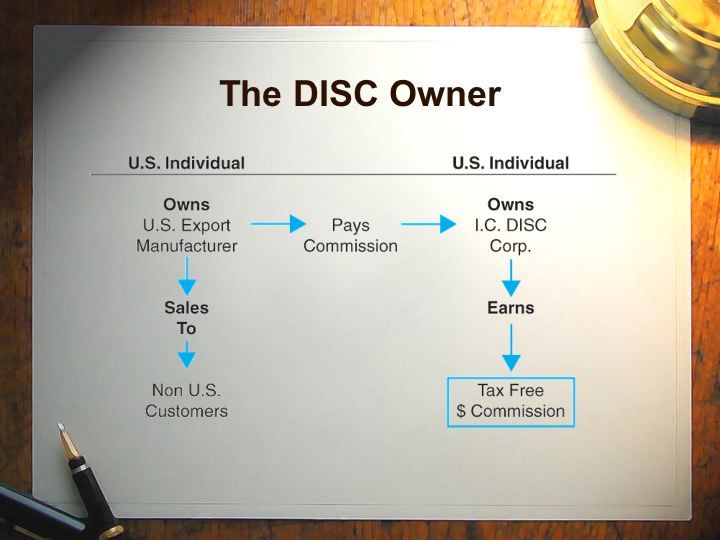
An IC-Disc is compensated by a U.S. taxpayer that manufactures, sells or licenses “export property”. Typically the U.S. taxpayer that establishes the IC-DISC will be related to the IC-DISC and even own the IC-DISC. The U.S. taxpayer agrees to pay the IC-DISC based on a Commission Agreement. A portion of the U.S. taxpayer’s export profits are paid to the IC-DISC and the payment is deducted from the profits of the U.S. manufacturer, seller or licensor. The portion of the U.S. taxpayer’s “export profits” that are paid to the IC DISC are measured under three profit scenarios. The deduction may exceed more than 50% of the U.S. Taxpayers’ export profits, depending upon gross income, profitability and costs.
In its simplest terms, the IC-DISC is a separate corporation. The income received by the DISC is not taxable to the DISC. The DISC is charged with accounting separately for a U.S. “taxpayer’s export profits” and receives more than 50% of the export profits free of any U.S. taxation.2/
The existence of the DISC will be transparent to the export company’s customers. The exporter will continue to operate its business in the same manner and its employees will continue to perform the company’s manufacturing, sales, billing, shipping and collection functions. The fact that there is a commission agreement between the exporter and the DISC will not have to be disclosed to the exporter’s customers and no documentation provided to the customers will need to indicate the existence of, or services deemed provided by the DISC.
Architects and engineers may also be surprised to learn that their services can also qualify of DISC benefits for construction projects located outside of the U.S. if professional services related to those projects can be performed in the United States.
What are the IC-DISC rules that need to be obeyed?
IC-DISC Rules
The IC-DISC must sell, lease, license or service “export property”
Export property means property:
Manufactured, produced, grown or extracted in the United States; held for sale, lease or rental, in the ordinary course of business, for use, consumption or disposition outside the United States; and Not more than 50% of the fair market value of which is attributed to articles imported into the United States.
Services Furnished by DISC
Services can also be provided by the I.C. DISC if such services are provided by the person who sold or leased the export property to which such services are related. The DISC acts as a commission agent with respect to the sale or lease of such property and with respect to such services that cannot exceed a certain amount of the value of the transaction. The service must be of the type of customarily and usually furnished with the type of transaction in the trade or business in which such sale or lease arose.
IC-DISC REQUIREMENTS
- A corporation taxable as a corporation, must be formed under the laws of any State or the District of Columbia to be the IC-DISC
- The corporation must have only one class of stock and minimum capital of $2,500. The IC-DISC shareholders may be related to the IC-DISC.
- The IC-DISC must take a tax election to be an IC-DISC that must be filed with the Internal Revenue Service within 90 days after the beginning of the tax year of the IC-DISC.
- The IC-DISC must maintain separate books and records.
- The IC-DISC must have at least 95% or more of its gross receipts considered to be Qualified Receipts resulting from the DISC’s export activities.Qualified export receipts of a DISC include gross receipts from the sale of export property by such DISC, or by any principal for whom the DISC acts as a commission agent. The transaction must be pursuant to the terms of a contract entered into with a purchaser by the DISC or by the principal at any time or by any other person and assigned to the DISC or the principal at any time prior to the shipment of such property to the purchaser. Any agreement, oral or written, which constitutes a contract at law, satisfies the contractual requirement of this paragraph.Qualified export receipts of a DISC include gross receipts from the lease of export property provided that the property is held by a DISC (or by a principal for whom the DISC acts as commission agent with respect to the lease) as an owner or lessee at the beginning of the term of such lease and entered into with the DISC for the DISC’S taxable year in which the term of such lease began.
- The IC-DISC must have at least 95% or more of its assets considered to be Qualified Export Receipts. For a corporation to qualify as a DISC, at the close if its taxable year it must have qualified export assets with an adjusted bases equal to at least 95 percent of the sum of the adjusted bases of all its assets. A qualified export asset held by a DISC is an export property that is a business asset used in the export business, export trade receivables, temporary export investments and several loans that can result from engaging in export financing techniques.
Essentially, as a practical matter, this means all IC-DISC gross receipts should be devoted almost totally to the IC-DISC operation. There is no reason to violate either of these formulas. However, there is no requirement that the IC-DISC be an actual operating company except the corporate form must be respected in all regards as with any other corporation.
“Thus the magic of the IC-DISC is to provide both tax deferral and to apply a 15% maximum dividend tax rate to profits that would otherwise be taxable in the U.S. taxpayer’s highest brackets that can range as high as 50% when city, state and federal income taxes are calculated.”
The Tax Benefits
The benefits of the IC-DISC come in two separate fashions. The IC-DISC shareholders may leave the IC-DISC profits in the IC-DISC and defer taxation until actual distribution of the profits or the IC-DISC may distribute profits to its shareholders like any other corporation. Since IC-DISC distributions are considered “qualified dividends” they are subject to a maximum tax of 15%. Thus the magic of the IC-DISC is to provide both tax deferral and to apply a 15% maximum dividend tax rate to profits that would otherwise be taxable in the U.S. taxpayer’s highest brackets that can range as high as 50% when city, state and federal income taxes are calculated.2/
Typically the IC-DISC is established, by a related company that is engaged in a United States business that includes gross revenues from both domestic and international sources. The related company’s principals will be the direct or indirect owners of the IC-DISC that may be owned directly or any transparent entity, that may be a partnership, or a disregarded entity, such as a one person limited liability company.
For the maximum tax advantage the IC-DISC shareholders should avoid double taxation by acting as individual shareholders or using disregarded entities and/or pass through entities. The IC-DISC corporation itself must be a c corporation and may not elect Sub chapter S status.
Tax Deferral
There is a cost to take advantage of the tax deferral tax benefit available using an IC-DISC. However, in today’s climate and for the foreseeable future, the cost is minimal. The IC-DISC rules provide that an “interest charge” must be calculated on IC-DISC distributions that are not paid as taxable dividends in the year earned. However, that interest charge is the same as the rates charged on one year Treasury bills that have been ranging at less than 1% per annum. Thus at this time a U.S. Taxpayer may defer the U.S. income tax on 50% or more of its export profits at a cost of less than 1% per year and then eventually distribute those export profits and their tax free earnings at the 15% U.S. dividend rate.
Major Savings
However, it is extremely important that U.S. taxpayers not be misled by the $10,000,000 annual cap on tax free income that is permitted by an IC-DISC. This $10. Million annual cap does not require the DISC pay taxes on its income of IC-DISC profits over $10.0 Million. The DISC remains tax exempt. This means that IC-DISC profits in excess of $10 Million annually will be immediately taxed to the shareholders as a DISC dividend.
Profits in excess of the $10.0 Million maximum are considered automatically annual dividends from the DISC with no deferral privileges. However, while the deferral privileges does not exist, most practitioners believe that the IC-DISC shareholders still will receive the 15% tax rate on the DISC dividends in excess of $10 Million.
The Commission Payments
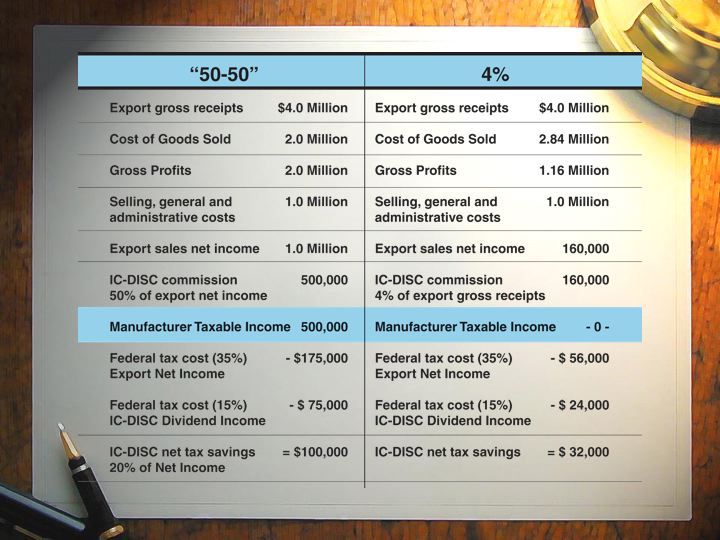
The commission payments will depend upon the pricing methodology chosen by a DISC to record its share of commission income at the greater of any of the following three pricing arrangements:
Gross Receipts Method
Under the gross receipts method of pricing, the transfer price for a sale by the related supplier to the DISC is the price as a result of which the taxable income derived by the DISC from the sale will not exceed the sum of (i) 4 percent of the qualified export receipts of the DISC derived from the sale of the export property and (ii) 10 percent of the export promotion expenses of the DISC attributable to such qualified export receipts.
Taxable Income Method
Under the combined taxable income method of pricing, the transfer price for a sale by the related supplier to the DISC is the price as a result of which the taxable income derived by the DISC from the sale will not exceed the sum of (i) 50 percent of the combined taxable income of the DISC and its related supplier attributable to the qualified export receipts from such sale and (ii) 10 percent of the export promotion expenses of the DISC attributable to such qualified export receipts.
“Export promotion expenses” means those expenses incurred to advance the distribution or sale of export property for use, consumption, or distributions outside of the United States but does not include income taxes.
Arm’s Length Method
If the rules of the preceding paragraphs are inapplicable to a sale or a taxpayer does not choose to use them, the transfer price for a sale by the related supplier to the DISC is to be determined on the basis of the sale price actually charged but subject to the rules provided by the rules of sales between related parties.
Payment
The amount of a transfer price (or reasonable estimate thereof) actually charged by a related supplier to a DISC, or a sales commission (or reasonable estimate thereof) actually charged by a DISC to a related supplier, must be paid no later than 60 days following the close of the taxable year of the DISC during which the transaction occurred.
Examples
The following are examples of the 4% Percent Gross Receipts and “50-50″ Combined Taxable Income Methods of Pricing. Neither example includes any export promotion expenses.
ARTICLE REFERENCES:
- As will be explained later, the “IC” stands for an “interest charge”. This is a cost to be paid to the extent the Domestic International Sales Corporation does not distribute its profits to its shareholders.
- IC-DISC income is also typically exempt from individual state income taxes.
ABOUT THE AUTHOR:
Richard S. Lehman, Esq., is a graduate of Georgetown Law School and obtained his Master’s degree in taxation from New York University.
He has served as a law clerk to the Honorable William M. Fay, U.S. Tax Court and as Senior Attorney, Interpretative Division, Chief Counsel’s Office, Internal Revenue Service, Washington D.C.
Mr. Lehman has been practicing in South Florida for more than 37 years. During Mr. Lehman’s career his tax practice has caused him to be involved in an extremely wide array of commercial transactions involving an international and domestic client base. He has served clients from over 50 countries.
If you have additional questions - please fill out the form below.
To Members of the Bar and other Professionals.
In this ever expanding global world; consider Richard S. Lehman, Esq., and LehmanTaxLaw.com as your in-house international tax law office. Don’t lose clients because you cannot supply the “tax law” piece of the puzzle. Lehman Tax Law has mastered the art of providing international tax advice by internet and will travel where warranted. Arrangements can be made for simultaneous translations and speedy delivery of translated documents in 10 languages to best help service your client.
Mr. Lehman understands professionals are now frequently dealing with alien individuals or foreign corporations investing in, doing business in, or moving to the United States; and/or Americans investing and doing business outside of the United States, or emigrating from the United States. This means that more and more professionals are going to deal with the U.S. tax laws and the world.
The best rule to follow in the field of tax law is to plan legal matters and obtain precision advice in advance to insure commercial endeavors are completed at minimum tax costs and personal lives are minimally disrupted. This is even more the case in the international field.
Mr. Lehman has been around long enough and experienced enough to know that the world of commerce is far from a perfect world. He knows how to apply his knowledge, experience and relationships just as effectively to resolve the unplanned and unexpected legal obstructions that arise in transactions that often lead to failure if not dealt with correctly. It is important to know – Mr. Lehman is just as good in cleaning up the legal mess of others – as making sure a legal mess does not happen in the first place.
For 37 years Richard S. Lehman has been a resource of knowledge in the area of United States taxation. After graduating Georgetown Law School, the New York University Law School Masters program in Taxation and serving as a law clerk on the U.S. Tax Court and with the Chief Counsel’s Office in the Internal Revenue Service in Washington D.C., Lehman has practiced U.S. tax law for 37 years with an emphasis on its international aspects. He has served clients from over 50 countries.
Please contact Mr. Lehman if you require his tax law expertise.
NEW U.S. TAX LAW Seminar Series: 5.5 hours FREE Continuing Education Course Credits
These seminars cover a complete range of topics dealing with legal and practical advice for foreign investors that invest in United States businesses, United States real estate and United States securities; and aliens that immigrate to the United States. This includes income, estate and gift tax planning for nonresident alien individuals and foreign entities such as foreign corporations, foreign trusts and foreign partnerships. Special sections are devoted to foreign investors in United States Real Estate, Tax Planning and Pre Immigration Tax Planning.
Also included in this group of seminars is a thorough study of the United States tax laws governing the tax deductions and tax refunds available for victims of Ponzi Schemes and other theft losses under the Internal Revenue Code Section 165. www.ustaxlawseminars.com
WATCH A SHORT OVERVIEW OF SEMINAR FORMAT:
America continues to be the ultimate destination point for many wealthy immigrants. Some from countries with taxes higher than the U.S. but most from countries with either lower taxes than the U.S. or countries with higher taxes that for all practical purposes are circumvented to one degree or another.1
An immigrant coming to America for longer than a certain time period will become a Resident Alien for U.S. income taxes at some point in time. In doing so, they are subjecting themselves to a potential U.S. tax income on their annual worldwide income, an estate tax on their deaths on their worldwide assets and a tax on gifts of their worldwide wealth.2
Presently the United States taxes its citizens on their worldwide income and gains. The tax is on net income and the U.S. tax code provides for numerous deductions and tax credits in arriving at net income. The tax rates on net ordinary income start at a rate of 15% and graduate to a high of 35% on $10.0 Million or more.
There is a different tax rate for gains from the sale of investment assets and other capital assets. Gains from the sale of capital assets held for more than a year have a maximum tax of 15%.
These income taxes can be mitigated to one extent or another for the potential u.s. immigrant, by careful tax planning before the immigrant becomes a resident alien.
Tax Residency in the U.S.
The first step in income tax planning is for the Nonresident alien who is immigrating to the U.S., to determine exactly when that immigrant will become a Resident Alien for income tax purposes.
The general rule is that an alien is not considered to be a Resident Alien for U.S. income tax purposes if the alien does not have either (1) a green card representing permanent residency in the U.S. or (2) a “substantial presence” or time period in the U.S. as described below. There are exceptions to this “substantial presence” general rule that will also be discussed.
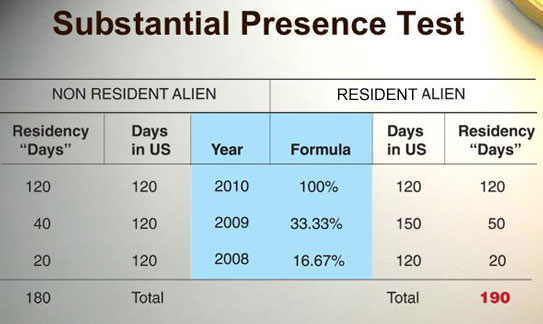
An alien individual has a “substantial presence” in the United States, or may become a Resident Alien subject to tax on worldwide income for any calendar year in which the alien is both physically present in the U.S. for at least 31 days and; in that same calendar year is considered to have been in the U.S. for a combined total of 183 days or more over the past three years pursuant to a formula.
For purposes of calculating this combined 3 year, 183-day requirement; each day present in the United States during the current “combined” calendar year counts as a full day, each day in the preceding year as one-third of a day and each day in the second preceding year as one-sixth of a day. This is shown on the example below.
The United States has tax treaties with many countries. These treaties generally provide that the residents and corporations of each country are entitled to a more liberal tax treatment than residents and corporations of non-treaty countries. The concept of tax residency under the treaties is usually different than the general definition and may permit a nonresident alien to spend more time in the U.S. each year without being a U.S. tax resident. Generally, the tax treaties will permit the alien individual to remain a non-resident for U.S. tax purposes so long as the alien covered by the treaty stays less than 183 days in the U.S. each separate year; and not over the cumulative three year period.
This same type of treatment that is granted under the Treaty, that of permitting aliens to have an extended stay in the U.S. of less than 183 days in each year without becoming a U.S. tax resident, is also available to certain aliens that are not from countries governed by a U.S. tax treaty. If an alien has his or her provable most important business ties to his or her native country; the substantial presence test is extended due to their “closer connection” to a foreign country than to the U.S.
The “Income Tax Residency Starting Date”
Generally there will be a specific point in time when the Nonresident Alien becomes a “Resident Alien” for U.S. tax purposes. This is an important date since it represents a total change in tax regimes and the point in time when all of the individual’s tax planning as a nonresident alien must be completed if it is to be successful. Pre Immigration tax planning generally cannot be accomplished after the Residency Starting Date.
There are different starting points of “income tax residency” during the year, depending upon the circumstances of obtaining the residency. Those are known as the “Residency Starting Dates”.
For example, once the alien individual has passed the “substantial presence test”, the individual is considered to be a Resident Alien from the beginning of the calendar year in which the test was exceeded.
On the other hand an individual who becomes a Resident Alien because of the issuance of a “green card” that represents permanent residency does not have a Residency Starting Date for tax purposes until that point in time during the year that the alien has received the green card and is present in the United States. However, if a “green card” recipient is a resident under both the green card test and the “substantial presence test”, the taxpayer’s taxable year is the full calendar year and not that date of the year in which the substantial presence in the U.S. physically began.
Missing a Residency Starting Date for the completion of pre residency tax planning transactions often will be fatal.
The Income Tax Objectives
1. A Nonresident Alien, prior to becoming a U.S. tax resident will want to make sure that he or she does not have to pay a U.S. tax on gains that have accrued as a practical matter before their residency period. The first strategy is to accelerate (realize and recognize) any and all gains earned by the Taxpayer prior to becoming a Resident Alien.
2. The second key strategy is to accelerate income that is expected to be paid after residency. Income payments should be collected prior to residency to avoid being taxed by the U.S.
3. The third strategy is to defer recognizing a loss until after obtaining tax residency as a Resident Alien so that the loss can be used against post residency gains. Assets with a fair market value below cost can be sold after residency. Those losses may be taken against gains in assets earned after U.S. residency. These losses can reduce or wipe out gains from the sale of assets that accrue after U.S. residency.
4. The fourth strategy is to defer paying deductible expenses until after the Residency Starting date. Many types of payments (both business and personal) in the U.S. are deductible from a U.S. Taxpayer’s income to determine the actual taxable amount of income.
ACHIEVING THE OBJECTIVES
Accelerate Gains Prior to Residency Starting Date
An example of acceleration would be to trade securities with unrealized gains and sell them before residency. There would be no tax on the gain. If the Taxpayer cares to keep the shares, the taxpayer can repurchase the shares immediately with a new high cost basis for U.S. tax purposes.
Assume a nonresident alien owned $1.0 Million Dollars worth of shares of Ford Motor Company that was purchased for $100,000. If the shares are sold after U.S. tax residency is assumed when the immigrant is a Resident Alien, there will be a tax on $900,000 in gains. A sale of these same shares by a Nonresident Alien before becoming a Resident Alien would result in no taxable gain.
There are multiple ways to accomplish this acceleration of gain. Another example would be that of an individual who owned a private foreign corporation that was not listed and could not be bought and sold on an exchange. Assume, like the prior example, the owner has a cost basis in the shares of $100,000 and the corporation is worth One Million Dollars. A liquidation of the corporation prior to the Residency Starting Date may result in the owner having a new cost or “tax basis” in the assets of the corporation received in the liquidation. This would be the $1.0 Million fair market value of the assets received. Assume a sale of these assets after the residency starting date for a purchase price of $1,200,000. This would only produce a taxable profit for U.S. tax purposes for $200,000
Under certain circumstances appreciated assets can be sold for tax purposes to a trust or family members to accomplish the increased basis for tax purposes of the appreciated assets. This allows the transferor to retain certain rights in the asset in spite of the transfer to another entity or person. Each asset must be carefully dealt with on an individual basis.
One extremely favorable U.S. Internal Revenue Service announcement has ruled that if a nonresident alien sells an asset prior to becoming a Resident Alien for a promissory note and not immediate cash, the proceeds of the note when received will not be considered taxable even after the residency starting date. The sale is considered to be completed and the funds are earned for tax purposes when the sale took place during the Taxpayer’s Non Resident Alien statue.
An example of the above might find a non resident alien father selling a valuable painting worth millions more than its cost to his nonresident alien son for a Promissory Note. The purchase price cash payment on the Promissory Note can be made tax free to the father when the son later sells the painting and after the father immigrates to the U.S. This is because the sale to the son realizing the gain was made prior to the Resident Alien starting date.
A sale by the son of the painting after the Residency Starting date will result in no taxable gain to the father to the extent of the original sales price. Amounts paid in excess of this would be taxable only to the son who most likely is not subject to U.S. taxes.3
There are several sophisticated and complex tax moves or actual sales that can be completed to accomplish this increase in basis or actual sales when foreign corporations comprise some or most of the would be immigrant’s wealth.
Accelerate Income Prior to Residency Starting Date
So long as an immigrating alien is not a Resident Alien, any and all income items that the Non Resident Alien earns from non U.S. sources before becoming a Resident Alien, should be accelerated for tax purposes so that the recognition of this income occurs prior to the taxpayer becoming a resident alien. This can include a host of different types of income, all of which may be treated in different ways in order to accomplish the acceleration of the income.
For example, assume a non resident alien owns a foreign corporation that conducted a business in his home country that now has $1 Million in receivables that will not be collected until after the owner has become a Resident Alien for U.S. tax purposes.
These receivables might be accelerated, for example, by the liquidation of the taxpayer’s company and the transfer of the receivables to the taxpayer at their present fair market value, prior to the Residency Starting Date.
The taxpayer may also sell his interest in the company or to the company for a Promissory Note. The ongoing foreign company may collect the receivables which are then paid to the seller and Non Resident Alien, in payment of the Promissory Note he received to sell his shares to the company.
Another type of deferred income that should be accelerated prior to U.S. tax residency is money from deferred compensation plans, such as pensions and profit sharing plans. Early releases and distributions of these type of payments in a lump sum from the plan would prevent the taxation of the distributions after one becomes a Resident Alien. In fact, there are several sophisticated techniques involving both annuities and life insurance products that could be very helpful in this regard. This same principal can apply to the acceleration of stock options and other forms of deferred and incentive compensation.
Actually any type of non U.S. periodic payment that the immigrating non resident alien can receive in advance prior to becoming a Resident Alien should be sought. For example, rental payments on personal property and real property can be paid in advance as can royalties and license fees, and even interest payments on promissory notes. If the immigrating taxpayer is not in a country where the taxes on these types of income are extremely low, there is a good deal of tax savings in paying attention to the acceleration of income items.
Defer Recognizing Loss
In today’s times there are many wealthy immigrants coming to the U.S. who have significant losses in their investment portfolios from the last few years. If it is economic, these portfolios should not be liquidated and losses should not be realized and recognized prior to immigration to the U.S; as they can be extremely valuable to use against capital gains in the U.S.; and even against ordinary income in the U.S. under certain circumstances.
Assume a non resident alien taxpayer from Panama has purchased a Panama apartment at the high end of the market for $4.0 Million, and it is worth $3.0 Million before he immigrates to the United States. Assume the Panamanian taxpayer will be immigrating to the U.S. effective January 1, 2011. Assume that same taxpayer invests $100,000 in a Florida corporation after obtaining tax residency and sells the Florida corporation after obtaining Resident Alien status for $1 Million in excess of its cost to the Panamanian investor.
In the event the investor were to sell his Panama apartment at a loss prior to becoming a Resident Alien and then sell his profitable Florida corporation at a gain in the following year when he is a Resident Alien, there will be a capital gains tax on the $1.0 Million gain at a cost of $150,000. Had the Panama apartment8 been sold in the year of Residency there would be no tax cost at all since as a Resident Alien, the taxpayer would pay a tax on all of his worldwide net losses and gains, thereby reducing his U.S. gains by his Panama losses.
Deferring the Payment of Deductible Expenses
The same principal that would work in deferring the payment of losses is also present in the principal of deferring the payment of deductions from the year of non residency to the year of tax residency.
The United States has a complicated tax code and offers numerous different “personal deductions” and “investment” or “business deductions” that will reduce the taxpayers overall tax burden. Most of these deductions are available only in the year of payment and several are subject to limitations. Nevertheless, an immigrating taxpayer should be familiar with the deductions that can be deferred.
One simple example. There is a limited deduction for medical expense that can reduce the taxpayer’s taxable income if those medical expenses are paid after obtaining Resident Alien status, they might reduce the taxpayer’s overall taxable income.
Preparing for the Future
Finally, the immigrating Non Resident Alien must prepare for a tax life as a Resident Alien. This means taking advantage of all of the tax deductions and tax investment incentives offered by the U.S. Tax Code. It may actually mean leaving certain of the taxpayer’s foreign investments in place. This is also the subject of a separate article on the Taxation of Immigrating to the United States.
FOOTNOTES:
- This article focuses on foreign individuals that are not U.S. citizens but who nevertheless may be classified as a U.S. resident for U.S. income tax purposes. (“Resident Alien”). A non-citizen who is classified as a nonresident for U.S. income tax purposes is referred to herein as a “Nonresident Alien”.
- This Article is directed only to income tax planning. A forthcoming Article will consider Estate Tax Planning for the U.S. Immigrant. All of the income taxes discussed are subject to numerous exclusions, deductions and tax planning techniques that make the U.S. taxes within reason. However, the immigrant from countries where the taxing authorities are lax will find the U.S. taxing authorities to be very vigilant.
- It is important to note that not all of an immigrating alien’s foreign assets need to be sold or exchanged or otherwise alienated. Good tax planning when one becomes a Resident Alien for tax purposes may mean keeping good foreign investments. Such assets will often fit well in the overall scheme because the U.S. taxes, on certain types of foreign income from outside the United States that is earned in a business, can be deferred and paid at a later point in time when the cash from the foreign business is actually distributed to the taxpayer.
Once you have read this article, please visit this free online seminar dedicated to pre immigration tax planning. The seminar pre immigration seminar is free.
In March of 2009, the IRS issued two documents to explain the “theft loss” deduction for tax purposes and to ease the administrative burdens for those claiming tax deductions and refunds for theft losses from Ponzi Schemes.
One document known as Revenue Ruling 2009-9, (the “Revenue Rule”) spelled out in detail, the general law of theft loss deductions and Ponzi Schemes in particular.
The second I.R.S. document spelled out certain conditions under which I.R.S. would allow theft loss deductions for Ponzi Schemes without audits and administrative slow down. This document was known as Revenue Procedure 2009-20 and it spells out a tax concept known as a “Safe Harbor”. If the Taxpayer stays within the conditions of the Safe Harbor, their tax deduction was safe.
A Safe Harbor is a tax position spelled out by the I.R.S. defining guidelines within which the I.R.S. will not challenge a Taxpayer’s tax position, so long as the tax position fits within certain parameters demanded by the I.R.S. The I.R.S. knows that the Taxpayer would win in court within the parameters set in the Safe Harbor. Therefore, the I.R.S. says, let’s not fight it but rather formalize it.
However, there are many reasons a Taxpayer victim of a Ponzi Scheme will either not fit in the Safe Harbor or will be forced to waive valuable tax rights in the event they choose the Safe Harbor. Therefore it makes sense to study how to deal with the I.R.S. if you have a theft loss and you will not or cannot use the Safe Harbor.
I. No Access to Safe Harbor?
The best example of when a Taxpayer-victim will not be entitled to the Safe Harbor for not meeting a “Safe Harbor” rule is found at Section 4.02 of the Safe Harbor which holds that there is no “theft” for purposes of the (Safe Harbor) unless:
(1) The lead figure (or one of the lead figures, if more than one) was charged by indictment or information (not withdrawn or dismissed) under state or federal law with the commission of fraud, embezzlement or a similar crime, that, if proven, would meet the definition of theft for purposes of § 165 of the Internal Revenue code and §1.165-8(d) of the Income Tax Regulations, under the law of the jurisdiction of which the theft occurred; or
(2) The lead figure was the subject of a state or federal criminal complaint (not withdrawn or dismissed) alleging the commission of a crime described in Section 4.02(1) of the Revenue Procedure, and either -
(a)The complaint alleged an admission by the lead figure, or the execution of an affidavit by that person admitting the crime; or
(b) A receiver or trustee was appointed with respect to the arrangement or assets of the arrangement were frozen.
This part of the Safe Harbor in essence defines the status of the level of proof that the I.R.S. must see to be sure a “theft” has been committed before allowing the tax deduction. However, there are many Ponzi thefts that are entitled to a “theft loss deduction” that never reach this level of prosecutorial attention.
The definition of a “theft” for tax deduction purposes is spelled out in the Revenue Rule as follows. As one can see the definition of “theft” under the law is much broader than the I.R.S. definition of theft for the Safe Harbor. The I.R.S. defines a deductible theft as:
For federal income tax purposes, “theft” is a word of general and broad connotation, covering any criminal appropriation of another’s property to the use of the taker, including theft by swindling, false pretenses and any other form of guile . . . “theft” includes larceny and embezzlement. A Taxpayer claiming a theft loss must prove that the loss resulted from a taking of a property that was illegal and had criminal intent under the law of the jurisdiction in which it occurred. A taxpayer need not show a conviction for theft.
Many taxpayers fit this legal definition of “theft loss” for tax deduction purposes but do not fit into the Safe Harbor.
Refusing the Safe Harbor – Waiver of Amended Returns
There are also reasons why a Taxpayer may not want to use the Safe Harbor even if the Taxpayer qualifies. A major drawback of the Safe Harbor is that the Safe Harbor requires a Taxpayer to waive the right to file amended returns for prior years and eliminate only the Ponzi income in each of those years. Instead, the Taxpayer must claim the theft loss as a deduction only in the year of discovery and then carryback or carryover any excessive theft loss not applied in the year of discovery to other full taxable years.
There is a big difference between eliminating Ponzi income only, from a prior tax return and taking a theft loss for the Ponzi income in the year of discovery. It could be financially significant. After claiming a full deduction for a theft loss in the year it is discovered, losses in excess of those deducted against the income earned in the year of discovery can be carried back and carried forward. When a loss carryback or carryover is used to claim a refund it must be applied against the entire amount of income earned in the year of carryback.
The theft loss is applied against a full year’s taxable income in the carryback year or carryover year. This may average out to be a 20% tax rate for refund purposes in the year of the carryback and the actual Ponzi income (“Phantom Income”) may have been taxed at the thirty-five percent (35%) tax rate in the year it was taxed. A Taxpayer with a $1,000,000 Ponzi Scheme loss filing an amended return eliminating Phantom Income only; versus a return that claims a theft loss on that Phantom Income of One Million Dollars can mean an increase to the Taxpayer’s tax refund from $200,000 (20%) to $350,000 (35%).
Legal Support for Amended Returns
The Internal Revenue itself has recognized under certain circumstances that it is correct to amend one’s tax returns and eliminate the “Phantom Income” only from the taxable year being amended, thus making use of a tax deduction in the highest bracket.
Therefore the Taxpayer must think the calculations through before waiving the right to file an amended return that will eliminate only the Ponzi Scheme income.
Claw Backs
Another reason not to accept the Safe Harbor is if the Taxpayer is concerned that the Taxpayer may be subject to a “Clawback” as part of a Ponzi Scheme mess. If so, the Taxpayer must waive another valuable tax right in order to take advantage of the Safe Harbor. The Taxpayer is required to give up his or her rights to use Code Section 1341.1/
The Safe Harbor insists that the Taxpayer waive their right to make use of the Internal Revenue Code Section 1341 in the event they must repay money in a Clawback. Code Section 1341 gives the Taxpayer that paid tax on income from a Ponzi Scheme in a prior year who is required to pay that income back in a different year as a Clawback, a choice. The Taxpayer may take the theft loss deduction in the year that the deduction is most tax beneficial to the Taxpayer. That could be either in the year in which the payback or claw back was paid or in the year that the income that was clawed back was taxed. This is the case even if the statute of limitations is closed in the year that the original tax was paid.
This is a valuable right that the Taxpayer must waive for the benefit of the Safe Harbor.
1/ A Clawback is when the Trustee in a Ponzi Scheme after the collapse, seeks recovery against fellow Ponzi Scheme participants that may have “profited” (in a cash sense) from their participation as investors in the Scheme. For example, Mr. X invested $1,000,000 in Madoff and reported and paid tax on another $1,000,000 in Phantom Income. He also took cash distributions over the years of $1,200,000. The Trustee may wait to “claw back” the $200,000 to pay investors in the scheme that actually lost on a cash invested basis.
I. The Alternatives to the Safe Harbor
This is just a few examples of when the Safe Harbor does not fit. If it does not fit for the Taxpayer, what is the next step if one believes they have a theft loss? The best way to analyze the Taxpayer’s position is to actually compare the Revenue Ruling and the Safe Harbor rules. By studying the Safe Harbor and the law together one can see how to claim the benefits of the Safe Harbor without the Safe Harbor.
Actually, the reader will see that the two documents are really not that far apart and there is in fact complete agreement upon several points between the two documents. First we will examine where the documents differ and how to deal with the differences so that a theft loss deduction can be claimed outside of the Safe Harbor. Then we will see where they agree.
Defining Theft Loss
The two documents differ regarding the definition of the “theft” that will support a deduction. This we have already discussed. In order to use the Safe Harbor, the “theft” must be shown by a state or Federal indictment, etc. The Revenue Ruling recognizes clearly that for income tax purposes the word “theft” has a broader definition. The Safe Harbor, however, requires not only that for there to be a theft, it must result from conduct by individuals charged by an indictment, information or complaint that has been filed against the perpetrator of the theft.
This author has found that when the theft does not reach the level established in the Safe Harbor but is a theft for state criminal purposes, it is time to turn to a criminal lawyer in the state in which the theft occurred. If the incident is a theft under state law the Taxpayer should obtain a legal opinion from a criminal lawyer under the laws of that particular state that the taking of property amounted to a criminal theft under that state’s law. This is strong proof of the theft for tax purposes.
The law is clear that a taxpayer need not show a conviction for theft in order to obtain a theft loss deduction.
Year of Discovery
There are two other places where the Safe Harbor sets standards different from the law as described in the Rev. Ruling. These are the definitions for the Year of Discovery and the Amount of Deductibility of the Theft Loss in the Year of Discovery.
Both the Revenue Ruling and the Revenue Procedure are in agreement that the law requires that the theft loss deduction must be taken in the year of discovery. However, the two documents differ on defining the “year of discovery”
To enjoy the benefits of the Safe Harbor, the Taxpayer must accept that the year of discovery is directly related to the year in which the indictment, information or complaint against the perpetrator which led to the theft has been filed. Therefore, under the Safe Harbor, a fixed “year of discovery” is tied directly to the Federal or state actions against the perpetrator.
This can be a very important difference. Keep in mind that in many business and theft loss cases there will be no indictment, etc. as required by the Safe Harbor to prove theft. The Taxpayer, not in the Safe Harbor, must not only be able to prove a theft loss, he or she needs to show the year in which the theft was discovered. The “year of discovery” is proven by gathering the pertinent evidence to the year of discovery. Evidence must be preserved that shows when the fraud was first discovered. This can be such things as notices of the collapse of the investment, meetings with lawyers or other professionals regarding the collapse, letters to perpetrators, income tax returns that prove the Taxpayer either still believed in the Ponzi Scheme at a particular point in time and any other facts.
The courts in deciding the year of discovery of a theft have agreed on several principles that provide further guidance. In determining the reasonableness of a taxpayer’s belief of loss at a particular time, the courts recognize they must be practical and take the individual facts of each case on its merits.
The relevant facts and circumstances are those that are known or reasonably could be known as of the end of the tax year for which the loss deduction is claimed. The only test is foresight, not hindsight. Both objective and subjective factors must be examined.
The law provides good guidance on the year of discovery and it is very much the year in which the ordinary reasonable person knew they had a loss from the collapse of investment.
In this regard it would seem that the Safe Harbor leaves no room for flexibility whereas the case law of the Rev. Rul. are not as exacting on the determination of the year of deductibility. Proof will be the key.
Amount of Deductibility in the Year of Discovery
The only other major concept where the Safe Harbor differs from the law is in dealing with exactly how much of a theft loss can be recognized and deducted and taken advantage of in the year that it is discovered.
TO BEGIN WITH, BOTH DOCUMENTS AGREE THAT THE TOTAL AMOUNT OF A THEFT LOSS IS EQUAL TO THE TAX BASIS OF THE LOSS.
This discussion deals with how much of that loss can be taken as a deduction in the year of discovery only. There are other standards that determine the timing on the deduction for those losses not claimed in the year of discovery.
The standard that defines exactly how much of that total amount is deducted in the year that the theft is discovered is defined as the total amount of the loss reduced by any amount that represents a “reasonable prospect for a recovery”. To the extent there is a reasonable prospect of recovery, there will be no deduction in the year of discovery.
The Taxpayer’s legal rights as of the end of the year of discovery are all important and need to be studied to make a proper decision. One of the facts and circumstances deserving of consideration is the probability of success on the merits of any claim brought by the Taxpayer. This is because the filing of a lawsuit may give rise to an inference of a reasonable prospect of recovery. However, the inference is not conclusive or mandatory. The inquiry should be directed to the probability of recovery as opposed to the mere possibility. A remote possibility of recovery is not enough; they must be a reasonable prospect of recovery at the time the deduction was claimed, not later.
In the event the deduction is not taken in the year of discovery, it will eventually be taken as a deduction in later years. However, if the theft loss is not taken in the year of discovery it must meet a higher standard of proof to be deductible in any other year. Eventually at that point in time when the Taxpayer can “ascertain with a reasonable certainty” that there is no prospect of recovery, any unclaimed theft losses may be taken. This could be a significant long period of time to delay deduction for theft losses.
Safe Harbor – Fixed Percentages
The Safe Harbor has definitely delivered the Taxpayer a favor in clarifying the amount of the theft loss deductible in the year of discovery by clearly defining certain percentage amounts that can be deducted under varying circumstances in the year of discovery to account for “contingent recoveries”.
Prior to the establishment of these fixed percentages by the I.R.S., the Taxpayer has always been dependent upon case law and accounting presentations to prove the amount of the deduction available in the year of discovery.
There are three groups of potential recoveries that both documents agree will reduce a theft loss in the year of discovery. That is three groups that represent a “prospect of recovery” in the year of discovery.
1. Recoveries from Insurance, Guarantees and Agreement to Limit Losses.
Essentially the Safe Harbor and the Rev. Rul. both agree that any amount of the loss claimed in the year of discovery as a deduction must be reduced by amounts actually recovered in the year of discovery or amounts that will be recovered as a result of insurance policies of any other contractual arrangements or guarantees that would repay the taxpayer for any of the theft loss claimed. This also includes government insurance companies such as the Securities Investors Protection Corp.
However, “all reasonable prospects of recovery” cannot be so easily quantified. THIS IS WHERE THE SAFE HARBOR IS MOST HELPFUL. THE SAFE HARBOR PROVIDES TWO (2) FIXED PERCENTAGES FOR THE TWO GROUPS THAT QUANTIFY THE BALANCE OF POTENTIAL UNKNOWN AND CONTINGENT RECOVERIES THAT COULD OTHERWISE REDUCE THE AMOUNT OF THEFT LOSS IN THE YEAR OF DISCOVERY.
Those two potential contingent amounts of recovery are as follows:
2. Recovery from those Responsible for the Ponzi Scheme. “The Responsible Group”. The Safe Harbor states that if the only people from whom the Taxpayer expects recovery of the Taxpayer’s total theft loss are the people who perpetrated the crime, then in the year of discovery the Taxpayer may deduct 95% of the total theft loss.
It is presumed by the I.R.S. that the Taxpayers will not recover more than 5% of the Taxpayers’ loss from the actual perpetrators.3/
If the Taxpayer is not in the Safe Harbor the Taxpayer will still be able to deduct 95% or more of the total loss. However, without the Safe Harbor the Taxpayer is going to have to prove his or her case. There is at least one case that supports that the 5% reduction in the loss, in the event the perpetrator is the only source of recovery, is acceptable to the courts.
3/ This “concession” of 5% that is reflected in the Safe Harbor Standard obviously reflects the long history of case law and experience that shows that recovery from the perpetrators of the Ponzi Scheme’s themselves will rarely be more than 5% as recovery towards the overall loss. As major fees and litigation are involved in obtaining this recovery. These fees reduce the recovery.
The Taxpayer will need to establish that he or she is not seeking any other source of recovery than from the Perpetrators and that the chances of receiving a refund from the perpetrators is no more than 5%. The Taxpayer will need to provide the proof necessary to establish that the amount (most likely from the Trustees own records), that they will recover from the Perpetrators will be no more than 5% of their loss.
The big difference here to be overcome by the Taxpayer who cannot use the Safe Harbor is that the Taxpayer must be responsible to provide proof that the Trustees’ recovery will not be significant. This can be done with good accounting.
3. Recovery from Third Parties. The Safe Harbor also provides the Taxpayer with a percentage amount to quantify another unknown potential recovery that could reduce what a Taxpayer may claim as a deduction in the year of discovery. The Safe Harbor provides that if a Taxpayer is also seeking recovery from third parties by litigation such as the major brokerage firms or accounting firms, etc. that may be responsible for the fraud; in this situation, the Safe Harbor will reduce the amount of theft loss deduction in the year of discovery by an additional 20% of the total amount of the theft loss to account for the potential recovery loss.
In other words, if a Taxpayer is suing third parties and depending upon distributions from a Trustee representing the perpetrators, the Taxpayer must reduce their total theft loss by 25% in the year of discovery until these issues are resolved.
Again, the Taxpayer who cannot rely on the Safe Harbor is going to have to prove their case. It is here where good forensic accounting may make a major difference and where a taxpayer may be able to prove that their “third party recovery” will amount to certainly no more than and possibly even less than the 20% amount allowed under the Safe Harbor rules.
DOCUMENTS IN AGREEMENT
As we stated, there are also many places where the Safe Harbor and the law agree.
Phantom Income as a Basis for Theft Loss.
The Rev. Rul. And the Safe Harbor do not disagree on the legal point that Phantom Income, which has been taken in as income and upon which tax has been paid by a Ponzi victim, may be the subject of a theft loss and becomes part of the tax basis that is deductible as a theft loss.
In order to be prepared to establish that tax has been paid on Phantom Income, all Taxpayers should include in their claim for refund, every tax return upon which Phantom Income appears as part of any submission to the I.R.S. There is no reason not to include each and every one of the Taxpayer’s income tax returns and any other vital information relevant from previous years to prove Phantom Income. There will be many other records that will support the payment of taxes on Phantom Income. All of this needs to be preserved.
Finally, both documents are in agreement on certain legal points that make life easier for the Taxpayer. These are:
Ordinary Income Deduction
Both documents agree that the theft loss deduction is a deduction of ordinary income and is entitled to be used as a net operating loss carry back or carry forward.
A Business Deduction
Both documents agree the theft loss deduction in a Ponzi Scheme is a business deduction that is not reduced by any of the percentage dollar limitations applicable to other types of casualty and theft losses.
Pass Through Entities
Both the Rev. Rul. and the Safe Harbor Agree those Taxpayers in “pass through entities” such as limited liability companies and partnership will be entitled to take their portion of any of the theft loss directly in spite of the fact the loss is in the name of the entity.
Summary
In summary, the Safe Harbor is just the starting point for those who are victims of Ponzi Schemes and other business and investment related theft loss that do not meet its conditions. Tax refunds can be obtained without the Safe Harbor; sometimes it is even more valuable without it.
The road towards a tax refund will be slower and the Taxpayer is advised to gather the most evidence one can get their hands on to prove the “year of discovery”, the amount of the “Phantom Income” and the actual “reasonable prospects of recovery” in the year of discovery.
With the right evidence and the law on your side, theft losses from Ponzi schemes can lead to the same refunds as the Safe Harbor and even more, since interest will be paid on the refund from the time the taxes were paid in certain situations. This might not occur under the Safe Harbor, the Taxpayer may be better off without the Safe Harbor in many situations.
Personal Comments
I have always said the Ponzi Scheme is one of the best things that has happened to the I.R.S. in a long time. The reader will have heard the names Madoff, Sanford, Nadell, etc. Let’s assume that all together they created $200 Billion Dollars of Phantom Income, almost all of which was taxed by the I.R.S. in the 35% tax bracket. In other words I.R.S. made $70 Billion from the Ponzi Schemes. (35% x $200 Billion)
I have seen in my practice that a tremendous amount of this valuable theft loss tax deduction is not being used properly or at all by individual Taxpayers. It is going completely to waste because it
(i) it is not properly being used before the death of the Taxpayer, or
(ii) it can be used only against income that is taxable in the 15% tax rate because the Taxpayer’s income is now so low due to their Ponzi Scheme loss; or
(iii) deductions are being wasted by poor professional advice or lack of knowledge.
I believe the average total amount of Ponzi Scheme refunds that will be made by the I.R.S. will be at a tax rate that averages less than 15%. The I.R.S. will receive $70 BILLION in taxes from “Phantom Income” and after holding the Taxpayers’ money for ten years will return about $25 BILLION in refunds.
DO NOT GET CAUGHT IN THAT TRAP. SEEK PROFESSIONAL ADVICE.
This is principally an article about tax planning for the non resident alien individual and foreign corporate investor that is planning for larger size investments in United States real estate (“Foreign Investor”). That is investments of One Million Dollars ($1,000,000) or more.1
As a result of 35 years of Florida real estate experiences with foreign investors that purchase shopping centers, rental apartments, rental apartment houses, warehouses, land acquisitions and real estate development deals of all types, this article also has a few practical suggestions for the Foreign Investor.
In my judgment the first suggestion is that today the Foreign Investor has the time to think about making your purchase and it need not be hurried but one cannot wait for all of the signs of correction before committing. The U.S. real estate market is very depressed. At the same time the U.S. real estate market will not be depressed forever and may turn quickly when it turns.
Next, use only a very limited amount of borrowed funds. Because the U.S. real estate market is heavily depressed, it is extremely difficult at this time and full of opportunities and traps. The first trap is to finance your real estate with debt that requires an immediate need for funds to finance real estate that may not be leased or sold for a considerable time. You must be prepared for long term holding even if you are thinking short term.
Third, one must seek good professionals in the United States who are also knowledgeable about the needs of the foreign investor. You must have an independent tax lawyer, real estate lawyer, an accountant and several property appraisers to rely on.
Next, do not buy 2nd and 3rd class just because of its price. Buy first class. You can do this today in America and buy for great prices.
Tax planning for the foreign investor acquiring real estate with cash investments in the range of approximately $1,000,000 or more requires a look at both the U.S. income tax consequences and the U.S. estate and gift tax consequences.
Definitions of U.S. Taxes
The foreign investor will need to be concerned about three separate U.S. taxes. They are the income tax, the estate tax and the gift tax.2
There is a U.S. income tax that is applied on annual net income which starts at 15% and can be as high as 35% for both corporations and individuals. There is a tax on capital gains from the sale of assets which is only 15% to an individual taxpayer, but may be as high as 35% to a corporate taxpayer.
There is an estate tax when a non resident alien individual dies owning U.S. real estate or shares of certain types of entities that own U.S. real estate. The first $60,000 of value is excluded. Thereafter this estate tax can be as high as 45% of the equity value of the real estate.
There is also a gift tax if a non resident alien individual gifts U.S. real estate to a third party. This can be as high as the estate tax, depending upon the value of the gift.
The Individual Foreign Investor – The Problem of the Estate Tax
As a general rule, the individual foreign investor that invests in United States real estate in equity amounts of $1,000,000 or more is going to be forced to use a corporation formed outside of the United States (Foreign Corporations) somewhere in their investment structure if they are going to avoid the U.S. estate tax.
There are many exceptions to this general rule but it is still the general rule. The United States Estate tax is so onerous that the individual Foreign Investor will generally not want to assume the risk of his or her estate having to pay the United States a large tax on the death of the individual foreign owner.
The estate tax may not be a factor if one of the exceptions apply. For example, if the Foreign Investor is from a country with whom the United States has an Estate Tax Treaty, the U.S. estate tax may not apply to that foreign individual.
Furthermore, if the individual Foreign Investor is from a country that has its own high estate tax, then the U.S. estate tax may not be of concern because it can be credited against the Foreign Investor’s estate tax of his or her own country, so that there is no double estate tax.
However, for the most part, the individual Foreign Investor will have to rely on owning a Foreign Corporation as a holding company or as the direct owner of the U.S. real estate investment.
The problem with this solution to the U.S. estate tax by owning a Foreign Corporation is that in protecting the Foreign Investor from the U.S. estate tax, that Investor will generally have to pay a higher income tax from rental income that may be earned and on the ultimate sale of the assets because there is a higher tax on capital gains earned by corporations as opposed to individuals.
Term Life Insurance
Another alternative to having the best of both worlds from a U.S. tax standpoint is that an investor can pay United States income taxes as an individual investor or as a limited liability company while not being concerned with the effect of United States estate taxes in the event of a premature death by buying life insurance equal to the potential U.S. estate tax exposure. That alternative is for the Foreign Investor to acquire sufficient “term life insurance” that pays only a death benefit for the contemplated life of the investment. Depending upon the age of the investors, this may be an inexpensive solution.
As an example, assume an investor invests one-half of One Million Dollars in United States real estate which doubles in value and is still held by the Foreign Investor but worth One Million Dollars upon the foreign investor’s death. Assume a United States estate tax of $350,000 on the value of United States real estate. The annual cost of a $350,000 life insurance policy for say a ten year period only of a relatively young man or woman will not be at all prohibitive from a cost standpoint.
Income and Capital Gains Tax
With all of this in mind we can review the various options of U.S. real estate ownership by the larger Foreign Investor.
1. Individual Ownership of U.S. Real Estate.
An individual Foreign Investor may own U.S. real estate in his or her own individual name. This represents the simplest form of ownership with the least amount of paperwork involved. If it is rented out the individual owner will have to file a U.S. income tax return personally reporting the U.S. income.
This form of ownership is only chosen by a small percentage of Foreign Investors. This is for at least two reasons. The first reason is liability. The owner of U.S. real estate will be personally liable for any damages that result from that real estate. While often insurance is more than sufficient to cover such claims, most investors do not want to expose themselves personally to individual liability.
Furthermore, investors from many countries are fearful of revealing their wealth for security reasons, particularly if it is a large investment. An investor’s individual name as an owner of U.S. real estate will appear in the public records where that real estate is located.
This form of ownership does however provide the best income tax benefits. The individual investor will pay tax only on the investor’s U.S. income. Because of expenses and depreciation deductions, the Investor may only pay a tax from operations in a relatively small tax bracket.
The tax on the profit from the gain from the sale of the real estate will be only 15%.
If one does choose to own U.S. real state individually, the foreign individual investor may be subject to an estate tax in the event that investor was to die owning the U.S. real estate.
2. Limited Liability Company Ownership.
Foreign Investors may use an entity acceptable in every state in the U.S. known as a limited liability company. This type of company is treated as if it does not exist for U.S. tax purposes and therefore the tax consequences of owning a United States limited liability company that owns U.S. real estate is similar to the tax consequences described for the individual foreign investor above. A U.S. estate tax will apply to U.S. real estate owned by a limited liability company.
However, the big difference is that the limited liability company, as the name says, provides the investor with limited personal liability for losses related to the real estate investment.
What this means is that the individual foreign investor’s personal assets are not exposed to the liabilities of the investment. The limited liability company provides for the best income tax treatment and limited liability for the investor’s wealth.
3. U.S. Domestic Corporate Ownership.
The use of a United States corporation by an individual Foreign Investor who invests in the United States real estate is very limited by itself. That is because shares of stock in a United States corporation that owns U.S. real estate are also included in the foreign investor’s estate, if the foreign investor dies owning those shares. Thus ownership of a U.S. corporation to own U.S. real estate does not solve any U.S. estate tax problems. It does, however, create an extra tax burden for the foreign investor in United States real estate. That is because there will be an income tax on a United States corporation on the gain of the sale of the real estate asset that can be higher than the tax on the foreign individual investor. Unlike the tax on an individual, which is limited to 15%, the corporate tax can be as high as 35%.
There is however, one situation in which investment in United States real estate by the ownership of a United States corporation does make sense. If is as follows:
Gift of Shares
If the individual foreign investor intends to ultimately make a gift of his or her shares in a United States company that owns U.S. real estate to third parties, such as family members, etc., there will be no U.S. gift tax asserted on the gift of those shares. There would have been a U.S. gift tax had the real estate been given directly. Thus, the estate tax may be avoided with no gift tax payable if shares in a United States corporation that owns U.S. real estate are transferred prior to the foreign investor’s death.
4. The Foreign Corporation.
As a general rule, it is not a good idea for a foreign investor to use a foreign corporation that will then directly invest in U.S. real estate. This is because foreign corporations that invest in U.S. real estate can be subject not only to U.S. corporate income taxes but might also be subject to a branch tax equal to 30% of the foreign corporate investors’ undistributed U.S. profits.
A foreign corporation is, nevertheless, very often the investment vehicle of choice for a foreign investor that is investing significant amounts of money in U.S. real estate, such as $1 Million or more. This is because estate tax becomes a major potential liability for substantial fortunes invested in U.S. real estate and U.S. estate taxes may be completely avoided if the individual Foreign Investor owns a foreign corporation that may in turn own the U.S. real estate.
There are no estate taxes in this situation because when the Foreign Investor dies owning the U.S. real estate indirectly, the Foreign Investor only transfers to his or her beneficiaries, shares in the foreign corporation and there is no direct transfer of an interest in U.S. real estate.
This more complicated structure, in knowledgeable hands permits many tax planning opportunities.
U.S. estate taxes may be completely avoided if the individual Foreign Investor owns a foreign corporation that may in turn own the U.S. real estate.
5. Foreign Corporations and U.S. Corporations.
A more typical structure for a large investment in U.S. real estate is for the individual Foreign Investor to establish a 100% owned Foreign Corporation that becomes the 100% owner of a United States corporation that ultimately owns the U.S. real estate. For example, if the Foreign Investor were to establish a foreign corporation that became the 100% owner of a United States corporation that owned United States real estate, the Foreign Investor will be able to avoid any United States estate tax completely since nothing in the U.S. is transferred in the event of the death of the Foreign Investor.
The Tax Planning Opportunities
The more complicated structure of establishing a Foreign Corporation that owns a U.S. corporation that owns larger U.S. real estate investments provides several opportunities for income tax planning.
Liquidation of Company
The principal tax planning tool of the use of the Foreign Corporation that owns a U.S. corporation to own its U.S. real estate is to make sure that when the United States real estate is sold by the U.S. Corporation, that U.S. Corporation must be liquidated after the sale. In this fashion only one single U.S. tax is paid at the U.S. corporation level. The proceeds of sale may be transferred free of tax by the U.S. corporation after it has paid its U.S. tax if it is liquidated after the sale.3
Portfolio Loans
Another often used tax planning tool is known as the “Portfolio Loan”. As a general rule a Foreign Corporation or a U.S. Corporation that owns U.S. real estate will be able to deduct as a business deduction all of the expenses of that ownership, which include the payment of interest on loans made to acquire the real estate. As a general rule, loans made by a Foreign Investor to his or her own Foreign Company, U.S. Company or Limited Liability Company will be deductible by the company. However, the payment of such interest to the Foreign Owner of the company may be subject to a tax as high as 30% on the gross interest paid to the investing company’s foreign shareholder.
There is, however, a major exception to this general rule provided in the Internal Revenue Code. That is that a Foreign Investor who owns less than 10% of the real estate investment will be able to receive the interest that is deductible by the Foreign Company free of any U.S. tax whatsoever. This rule does not work in the event the investor owns 10% or more of the real estate investment or the entity that owns that real estate investment.
However, it is a useful planning tool in many situations where more than one investor is involved. In those situations where a portfolio loan can be used, the U.S. taxes on the income earned from the real estate investment will be reduced for the interest expense payable to the Foreign Investor without the payment of tax on that interest.
“. . . the U.S. taxes on the income earned from the real estate investment will be reduced for the interest expense payable to the Foreign Investor…“
Portfolio Loan Sales
There is another way to take advantage of the Portfolio Loan exclusion for interest paid to Foreign Investors. This can be accomplished at the actual time of sale by a Foreign Investor of his or her U.S. investment. To understand this, it is important to keep in mind that the portfolio interest deduction and exclusion from income is only appropriate if the Foreign Investor no longer has a 10% or less interest in the property.
Therefore a Foreign Seller may wish to sell the property, not for all cash but rather for cash and the balance due in the form of a note payable by the U.S. Buyer to the Foreign Seller who no longer owns any part of the U.S. real estate. At that point the Foreign Seller will be receiving tax free interest from the note that the Foreign Seller holds as a result of the U.S. real estate and the property can be used to secure the note until its full payment. This method of converting what otherwise might be taxable sales proceeds into tax free interest income could be of significant tax value under the right circumstances.
Like Kind Exchanges
Another method used by both Foreigners and Americans alike to grow their U.S. real estate portfolios free of U.S. tax is to make use of the “Like Kind Exchange Rules”. Essentially these rules hold that an investor in U.S. real estate may exchange the U.S. real estate project that they own for a different U.S. real estate project without paying any immediate tax on any gain or profit that may be accrued in the first investment.
For example, assume a Brazilian investor owns a U.S. corporation which owns raw land that the investor purchased for $ 3 Million. Assume the raw land is now worth $6 Million and the investor wishes to terminate his investment in the raw land and instead own an income producing asset such as a shopping center. Assume the shopping center is worth $ 6 Million.
Even though the raw land has increased in the amount of $ 3 Million, none of that gain will be recognized or will it become taxable until the Corporation actually sells the real estate that it has acquired as part of the exchange. At that point the investor’s investment in the shopping center has its original cost of $3 Million and any gain over and above that would be taxable if the shopping center were later sold.
… selling shares of a foreign corporation would result in no tax whatsoever being paid by the foreign entity trust on the shares of these stock.
Sale of Stock in a Foreign Corporation
In addition, on rare occasions, it has been possible for foreign investors to sell their shares in the Foreign Corporation that owns U.S. real estate to a third party buyer. It is clearly understood that selling shares of a corporation that owns real estate, instead of the actual real estate is not typical. However, this transaction, of a foreign entity selling shares of a foreign corporation would result in no tax whatsoever being paid by the foreign entity trust on the shares of these stock. There is a market for such transaction in the U.S. in specialized cases.4
FOOTNOTES:
- See article “Tax Planning for Foreign Investors Acquiring Smaller ($500,000 and under) United States Real Estate Investments” for a companion article on Tax Planning for Foreign Investors Acquiring Smaller United States Real Estate Investments.
- In addition, several of the individual states in the U.S. charge their own separate income tax on income earned in that state.
- Often one Foreign Corporation may be used as a holding company and will set up several U.S. corporations to own different projects. That way each U.S. Corporation may be liquidated on a deal by deal basis, leaving the Foreign Corporation in place.
- Another estate planning tool that allows a non resident alien investor to invest in United States real estate without incurring U.S. estate tax is the use of a Non Grantor Trust. This is a devise whereby the investor purchases the U.S. real estate using a foreign trust and foreign beneficiaries, such as family members, so that trust will ultimately benefit others. This vehicle is specifically not being discussed in this article since it does involve the investor’s alienation of the property to a trust that is extremely restrictive of any powers that the investor can have over the real estate owned by the Non Grantor Trust.
Richard S, Lehman, Esq.
TAX ATTORNEY
6018 S.W. 18th Street, Suite C-1
Boca Raton, FL 33433
Tel: 561-368-1113
Fax: 561-368-1349
Richard S. Lehman is a graduate of Georgetown Law School and obtained his Master’s degree in taxation from New York University. He has served as a law clerk to the Honorable William M. Fay, U.S. Tax Court and as Senior Attorney, Interpretative Division, Chief Counsel’s Office, Internal Revenue Service, Washington D.C. Mr. Lehman has been practicing in South Florida for more than 35 years. During Mr. Lehman’s career his tax practice has caused him to be involved in an extremely wide array of commercial transactions involving an international and domestic client base.
By Richard S. Lehman, ATTORNEY AT LAW
This is principally an article about tax planning for the non resident alien individual and foreign corporate investor that is planning for smaller size investments in United States real estate (“Foreign Investor”).1
As a result of 35 years of Florida real estate experiences with foreign investors that purchase condominium units, smaller homes and many other forms of U.S. real estate investments, this article also has a few practical suggestions for the Foreign Investor.
The first suggestion is that today the Foreign Investor has the time to think about making your purchase and it need not be hurried. The U.S. real estate market is very depressed. At the same time the U.S. real estate market will not be depressed forever.
Next, use only a very limited amount of borrowed funds. Because the U.S. real estate market is heavily depressed, it is extremely difficult at this time and full of opportunities and traps. The first trap is to finance your real estate with debt that requires an immediate need for funds to finance real estate that may not be leased for a considerable time. You must be prepared for long term holding even if you are thinking short term.
Third, one must seek good professionals in the United States who are also knowledgeable about the needs of the foreign investor. You must have an independent tax lawyer, real estate lawyer, an accountant and several property appraisers to rely on.
Next, do not buy 2nd and 3rd class just because of its price. Buy first class. You can do this today in America and buy for great prices.
Tax planning for the foreign investor acquiring real estate with cash investments in the range of approximately $500,000 or less requires a look at both the U.S. income tax consequences and the U.S. estate and gift tax consequences.
Definitions of U.S. Taxes
The foreign investor will need to be concerned about three separate U.S. taxes. They are the income tax, the estate tax and the gift tax.2
There is a U.S. income tax that is applied on annual net income which starts at 15% and can be as high as 35% for both corporations and individuals. There is a tax on capital gains from the sale of assets which is only 15% to an individual taxpayer, but may be as high as 35% to a corporate taxpayer.
There is an estate tax when a non resident alien individual dies owning U.S. real estate or shares of certain types of entities that own U.S. real estate. The first $60,000 of value is excluded. Thereafter this estate tax can be as high as 45% of the equity value of the real estate.
There is also a gift tax if a non resident alien individual gifts U.S. real estate to a third party. This can be as high as the estate tax, depending upon the value of the gift.
With all of this in mind we can review the various options of U.S. real estate ownership.
1. Individual Ownership of U.S. Real Estate
An individual foreign investor may own U.S. real estate in his or her own individual name. This represents the simplest form of ownership with the least amount of paperwork involved. If it is rented out the individual owner will have to file a U.S. income tax return reporting the U.S. income.This form of ownership is only chosen by a small percentage of foreign investors. This is for at least two reasons. The first reason is liability. The owner of U.S. real estate will be personally liable for any damages that result from that real estate. While often insurance is more than sufficient to cover such claims, most investors do not want to expose themselves personally to individual liability.Furthermore, investors from many countries are fearful of revealing their wealth for security reasons. An investor’s individual name as an owner of real estate will appear in the public records where that real estate is located.This form of ownership does however provide the best income tax benefits. The individual investor will pay tax only on the investor’s U.S. income and will probably only pay a tax from operations in a relatively small tax bracket. The tax on the profit from the gain from the sale of the real estate will be only 15%. If one does choose to own U.S. real state individually, the foreign individual investor will be subject to an estate tax in the event that investor was to die owning the U.S. real estate.
2. Limited Liability Company Ownership
Foreign investors may use an entity acceptable in every state in the U.S. known as a limited liability company. This type of company is treated as if it does not exist for U.S. tax purposes and therefore the tax consequences of owning a United States limited liability company that owns U.S. real estate is similar to the tax consequences described for the individual foreign investor above.However, the big difference is that the limited liability company, as the name says, provides the investor with limited personal liability for losses related to the real estate investment.What this means is that the individual foreign investor’s personal assets are not exposed to the liabilities of the investment. This is often the best vehicle for a smaller investor in U.S. real estate. The limited liability company provides for the best income tax treatment and limited liability for the investor’s wealth.
3. The Foreign Corporation
As a general rule, it is not a good idea for a foreign investor to use a foreign corporation that will then directly invest in U.S. real estate. This is because foreign corporations that invest in U.S. real estate can be subject not only to U.S. corporate income taxes but might also be subject to a branch tax equal to 30% of the foreign corporate investors’ undistributed U.S. profits.A foreign corporation is, however, very often the investment vehicle of choice for a foreign investor that is investing significant amounts of money in U.S. real estate, such as $1 Million or more. This is because estate tax becomes a major potential liability for substantial fortunes invested in U.S. real estate and U.S. estate taxes may be completely avoided if the individual foreign investor owns a foreign corporation that may in turn own the U.S. real estate.There are no estate taxes in this situation because when the foreign investor dies, the foreign investor has only transferred to his or her heirs’ shares in the foreign corporation and there is no direct interest in U.S. real estate.
4. U.S. Domestic Corporate Ownership
The use of a United States corporation by an individual foreign investor who invests in the United States real estate is very limited by itself. That is because shares of stock in a United States corporation that owns U.S. real estate are also included in the foreign investor’s estate, if the foreign investor dies owning those shares. Thus ownership of a U.S. corporation to own U.S. real estate does not solve any U.S. estate tax problems. It does, however, create an extra tax burden for the foreign investor in United States real estate. That is because there will be an income tax on a United States corporation that earns the income as a tax on the gain for the sale of the real estate asset. Unlike the tax on an individual, which is limited to 15%, this tax can be as high as 35% when earned by a United States corporation. This can also lead to double taxation when dividends are paid to a foreign investor from the United States corporation.There are however, two situations in which investment in United States real estate by the ownership of a United States corporation does make sense. They are as follows:
Gift of Shares
First, if f the foreign investor intends to ultimately make a gift of his shares in a United States company that owns U.S. real estate to third parties, such as family members, etc., there will be no U.S. gift tax asserted on the gift of those shares. There would have been a U.S. gift tax had the real estate been given directly. Thus, the gift tax may be avoided if shares in a United States corporation are transferred prior to the foreign investor’s death. By gifting the shares the original owner will avoid the estate tax.
5. Foreign Corporation and U.S. Corporation.
Another extremely important use of a United States corporation is when it is part of a chain of corporations that ultimately owns the U.S. real estate. For example, if the foreign investor were to establish a foreign corporation that became the 100% owner of a United States corporation that owned United States real estate, the foreign investor will be able to avoid any United States estate tax completely since nothing in the U.S. is transferred in the event of the death of the foreign investor.This method of ownership is often recommended for large investments in United States real estate where the estate tax can become a major issue. It does however involve potential double taxation and other traps and tax benefits that must be individually applied.
Term Life Insurance
There is another alternative to having the best of both worlds, which is to pay United States income taxes as an individual investor or as a limited liability company while not being concerned with the effect of United States estate taxes in the event of a premature death. That alternative is for the foreign investor to acquire sufficient “term life insurance” that pays only a death benefit for the contemplated life of the investment.
As an example, assume an investor invests one-half of One Million Dollars in United States real estate which doubles in value and is worth One Million Dollars upon the foreign investor’s death. Assume a United States estate tax of $350,000 on the value of United States real estate. The value of a $350,000 life insurance policy for say a ten year period only of a relatively young man or woman will not be at all prohibitive from a cost standpoint.3
FOOTNOTES:
- See article “Tax Planning for Foreign Investors Acquiring Larger ($1,000,000 and over) United States Real Estate Investments” for a companion article on Tax Planning for Foreign Investors Acquiring Larger United States Real Estate Investments.
- In addition, several of the individual states in the U.S. charge their own separate income tax on income earned in that state.
- Another estate planning tool that allows a non resident alien investor to invest in United States real estate without incurring U.S. estate tax is the use of a Non Grantor Trust. This is a devise whereby the investor purchases the U.S. real estate using a foreign trust and foreign beneficiaries, such as family members, so that trust will ultimately benefit others. This vehicle is specifically not being discussed in this article since it does involve the investor’s alienation of the property to a trust that is extremely restrictive of any powers that the investor can have over the real estate owned by the Non Grantor Trust.
Richard S, Lehman, Esq.
TAX ATTORNEY
6018 S.W. 18th Street, Suite C-1
Boca Raton, FL 33433
Tel: 561-368-1113
Fax: 561-368-1349
Richard S. Lehman is a graduate of Georgetown Law School and obtained his Master’s degree in taxation from New York University. He has served as a law clerk to the Honorable William M. Fay, U.S. Tax Court and as Senior Attorney, Interpretative Division, Chief Counsel’s Office, Internal Revenue Service, Washington D.C. Mr. Lehman has been practicing in South Florida for more than 35 years. During Mr. Lehman’s career his tax practice has caused him to be involved in an extremely wide array of commercial transactions involving an international and domestic client base.
TAXATION both DOMESTIC AND INTERNATIONAL
Mr. Lehman’s general tax practice has consisted of a wide range of representation acting as counsel in both the criminal and civil tax areas. In the domestic tax area, he has represented clients in almost every type of commercial endeavor. This has resulted in a familiarity and use of every form of entity for tax planning purposes. This includes among others limited partnership, limited liability companies and domestic and foreign corporations and trusts.
In the criminal tax area Lehman works along side of criminal defense lawyers so that creative tax theories can be blending with the strongest defense of constitutional rights. This often results in potential criminal cases being dismissed at administrative levels.
South Florida is a major center of international trade and investment. Mr. Lehman’s international practice spans the globe. This has resulted in Lehman’s representation of foreign investors giving tax and practical advice in acquiring and selling a wide range of commercial businesses and other U.S. investment assets. This includes not only the acquisition and sale of active businesses in the U.S. but also investments in all fields of real estate including raw land, shopping centers, commercial office buildings, condominiums, residential apartments, residential homes and the like.
In addition, Mr. Lehman has provided legal advice to Americans expatriating from the U.S. and have extensively restructured many non-residents’ holdings in conjunction
with their immigration to the United States. A very unique set of tax laws applies to non-resident aliens and foreign corporations in both the income tax and estate tax areas that provides for both tax traps and successful tax planning opportunities.
He has also represented numerous Americans working and investing outside the United States taking full advantage of another unique set of tax laws. Americans investing and working outside of the United States may benefit from excluding certain income earned outside of the U.S. or deferring the taxation of such income until a later point in time. At the same time there are tax traps for American investors investing internationally that must be avoided.
By Richard S. Lehman, Esq., of Richard S. Lehman P. A.; Boca Raton, FL
In last week’s column, we established that today’s business climate is extremely treacherous for all sizes and types of business. Whether a suit is won or lost, frivolous or legitimate , there are major distractions. Time is spent defending actions, while revenue-generating activities are curtailed. Similarly, large sums of money can be spent on defense.
In the first article, we analyzed a variety of asset protection entities. In this final segment, we will look at protected forms of investment. Business owners, directors of public companies, management and individuals should consider making use of these various methods of investment as another protection against liabilities.
Exemption equals protection.
Not only can there be protection from creditors by choosing the proper entity in which to hold assets, many types of investment assets are also protected from creditors by virtue of state and federal exemptions.All states have “exemptions” to designate categories of property interests that are immune from forced sale or seizure. Florida law provides an assortment of such exemption:
- Annuity and insurance contracts. Florida law protects the cash surrender values of life insurance policies and the proceeds of annuity contracts issued upon the lives of residents of the state. Creditors of the insured or the beneficiary cannot seize the assets unless the policies or contracts were for the benefit of the creditor.
- Life insurance trusts. Consideration of the life insurance trust provides an asset protection opportunity that makes use of the trust concept, the exemption concept and also provides for major estate and gift tax benefits. This type of trust, formed to handle life insurance proceeds, is similar to the domestic trust described in the previous article. Asset protection may be afforded by providing limitations on the beneficiaries’ interest. Under Florida law is also protection from creditors due to the exemption, and it also provides for the estate tax-free payment of life insurance death benefits to beneficiaries.
By placing the policy in a separate irrevocable trust, rather than owning the policy, the insured retains no “incidence of ownership.” The death benefits payable from the policy will not be included in the insured’s estate. If the insured does not use a trust or another person as the owner of the policy and retains any incidence of ownership, all of the death benefits will be subject to estate taxes.
All states have exemptions to designate categories of property interests that are immune from forced sale or seizure. Florida law provides an assortment of such exemptions. Homestead and other exemptions.
- Homestead protection. Florida provides unlimited protection for the homestead property and improvements. The limit on the size of protected property is up to one-half acre in a city or 16 acres in the country.
- Earnings of a head of household. Florida protects compensation for personal services or labor whether denominated as wages, salary, commission or bonus. The first $500 a week of such earnings are absolutely exempt from attachment or garnishment and anything above that amount will not be subject to attachment or garnishment unless such person has agreed otherwise in writing. Wages may be protected for six months after receipt.
- Disability insurance and disability insurance proceeds. Florida exempts disability payments from creditors, including lump sum proceeds resulting from settlement of a claim against a disability carrier.
- Pension plans and IRA’s. These are generally protected, but bankruptcy courts have found that pensions will not be protected from creditors in the event of inappropriate compliance with tax or labor laws. Among common defects that may cause this qualification are a failure to cover all employees requiring such coverage, inappropriate investments and loans, and prohibited transactions.
- Alimony rights. These rights are a protected asset.
- Unemployment compensation benefit rights. As defined by Florida law, these rights are exempt from all claims and creditors.
Keep in mind that these are cursory explanations of several asset protection strategies. Business owners should realize that their assets are always at risk, so it’s worth considering these plans with a professional as a way to protect what you’ve built personally and through your business.
Originally Published: May 31, 2002 in South Florida Business Journal
By Richard S. Lehman & Associates Attorneys at Law
The general principles discussed herein are not intended to be legal or tax advice and taxpayers should consult with their individual legal, accounting and tax advisors.
PRE-IMMIGRATION TAX PLANNING
What Can Be Accomplished Prior to Residency Status
South Florida continues to be a destination for legal aliens hoping to invest; do business and live in the United States. Very often immigrating residents are unfamiliar with the tax laws of the United States that they will face upon obtaining their resident status. Often this lack of knowledge can be costly with immigrants paying unnecessary taxes and burdening themselves with liabilities.
The following is a checklist of issues that may be helpful to avoid these tax problems. The checklist does not consider the effect of a tax treaty that may apply to an immigrant.
I. Status for Tax Purposes
- Resident for Income Tax Purposes
a. Green Card
b. Substantial Presence Test
c. Voluntary Election
- Resident for Estate and Gift Tax Purposes
a. Country of Domicile
II. Taxation Pattern
- Resident - Subject to Taxation
a. Income Taxation - Worldwide Income
b. Estate Taxation - Worldwide Assets
c. Gift Taxation - Worldwide Assets
- Non Resident Alien - Subject to Taxation
a. Income Taxation - United States Source Income, Limited type of Foreign Source Income
b. Estate Tax - United States Situs Assets Only
c. Gift Tax - Real and Tangible Personal Property with a United States Situs
- Situs of Assets
a. Real Property in the U.S. - U.S. Situs
b. Tangible Personal Property - Located in the U.S . - U.S. Situs
1. - Cash - Needs Special Consideration
2. - Exceptions for visiting art work
c. Intangible Personal Property - Dependent upon the type of intangible property
III. Pre-Immigration Planning - Income Tax and Gain
- Objective - Minimize United States Gains and Income Tax
a. Key Strategy is to accelerate gains prior to residency so that gains earned while one was a non resident alien are not subject to U.S. tax after residency is obtained. Some examples of acceleration of gain are:
b. Traded securities with unrealized gain may be sold before residency and repurchased with a new cost basis
c. Illiquid assets with unrealized gain may be sold to related parties or third parties and gain realized. Careful planning must be undertaken if one sells and repurchases illiquid assets; especially with related parties.
d. Income expected to be paid after residency should be accelerated where possible and paid prior to residency.
Some examples of acceleration of income are:
1. - Exercise stock options
2. - Accelerate taxable distributionsfrom deferred compensation plans
3. - Accelerate gains on Notes held from installment sales
IV. Pre Immigration Planning - Estate and Gift Tax
- Objective-Minimize United States Estate Tax
a. Key strategy is to minimize assets in one’s estate before obtaining residency status; and where possible to retain some degree of control over assets;
b. Planned gifts to third parties should be made prior to residency;
c. Planned gifts of United States Situs Property
1. - Tangible Property - Physical Change of Situs to a Foreign Situs Before Gift is made;
2. - Real Estate - Contribution to foreign corporation and gift of stock in foreign corporation.
d. Transfers in Trust for Beneficiaries
V. EXCEPTIONAL CIRCUMSTANCES AND SPECIAL TAX BENEFITS
- Students
a. A foreign student who has obtained the proper immigration status will be exempt from being treated as a U.S. resident for U.S. tax purposes even if he or she is here for a substantial time period that would ordinarily result in the student being taxed as a U.S. resident.
b. This student visa not only permits the student to study in the United States and pay taxes only on income from U.S. sources not worldwide income. The visa also permits the student’s direct relatives to accompany the student to the United States and receive the same tax benefits.
c. Assume the student, a Columbian woman aged 40, is married to an extremely successful Columbian businessman who accompanies her with their two children to the U.S. His annual income is $1.0 Million and is earned from the banking business in Columbia. He earns no U.S. income. Under those circumstances, for U.S. income tax purposes, this businessman is exempt from U.S. tax on his worldwide income while living full-time in the U.S. for less than five calendar years.
- Treaty Benefits
Aliens that are governed by a tax treaty can generally spend more time in the U.S. than an alien not covered by a treaty before being considered a resident alien for tax purposes.